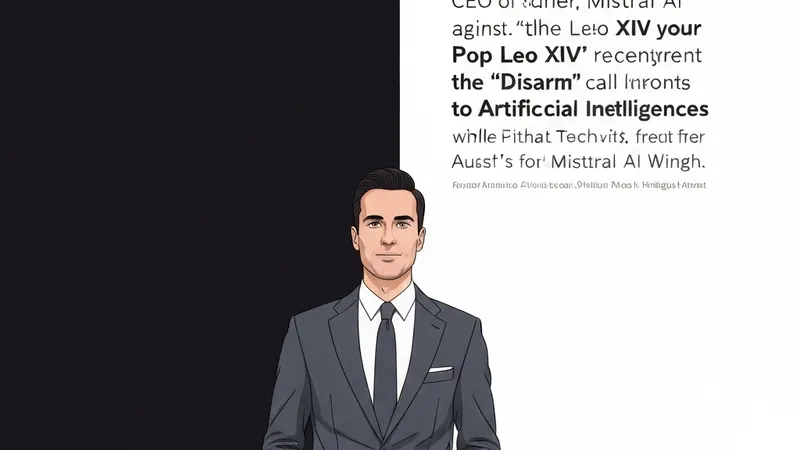
Mistral CEO Arthur Mensch is actively pushing back against Pope Leo XIV’s recent call to "disarm" artificial intelligence. Mensch argues that Europe cannot afford to fall behind U.S. tech giants in the race for advanced AI capabilities. "We’re all for peace, but if you look at our rivals and adversaries in the world, they’re using artificial intelligence... As long as we have adversaries that are threatening, and they are threatening, we do need to have our own capabilities," Mensch told reporters. His remarks came alongside Mistral's announcement of a new 10-megawatt data center near Paris and new partnership agreements with European industrial giants Airbus and BMW. The French AI firm is positioning itself as Europe's homegrown alternative to U.S. rivals like OpenAI, Google, Anthropic, and Microsoft.
Meanwhile, Pope Leo XIV criticized the rapid expansion of AI in a new papal encyclical titled Magnifica Humanitas, addressing issues ranging from deepfakes and AI companions to the technology’s impact on jobs and warfare. "In the era of artificial intelligence, when human dignity is threatened by new forms of dehumanization, ours is the pressing duty to remain profoundly human," the Pope wrote. In contrast, Mistral executives frame the development of artificial general intelligence (AGI) and superintelligence as matters of essential geopolitical security for Europe.
Guillaume Lample, Mistral’s co-founder and chief scientist, emphasized that AGI is on the horizon. "Very soon in the future, we are probably going to see AGI or superintelligence, so it is very important that we have access to these models also in Europe," Lample stated. He warned that lacking independent access to these models could block Europe from accessing massive scientific breakthroughs, such as cancer cures. This push for technological sovereignty is amplified by changing transatlantic dynamics, prompting European leaders like French President Emmanuel Macron to call for greater technological and defensive independence. Consequently, the French government has begun replacing American software like Microsoft Teams with domestic alternatives, and the French armed forces have officially partnered with Mistral to deploy its AI models.
[AgentUpdate Depth Analysis] The clash between Mistral's secular realism and the Vatican's ethical caution underscores a pivotal shift in the AI landscape: AI is no longer just a software product, but a vital instrument of state power and national security. In the emerging AI Agent ecosystem, absolute reliance on foreign foundational models poses an existential threat to domestic digital infrastructure. By securing strategic partnerships with the French military, Airbus, and BMW, Mistral is pioneering a blueprint for "Sovereign AI Agents." This ensures that highly sensitive domains—such as defense, aerospace, and heavy industry—can deploy autonomous agents without exposing critical data to foreign jurisdictions. Mistral’s trajectory suggests that the future Agent ecosystem will likely fragment into regional, highly regulated clusters, where technological independence is prioritized over global standardization.