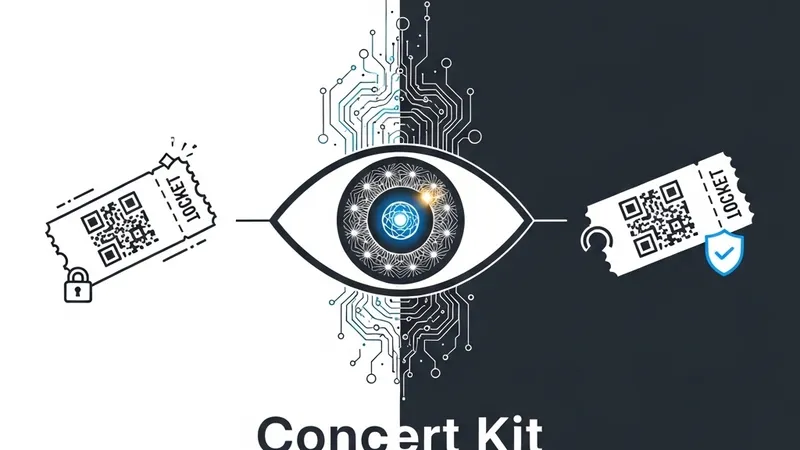
If you subscribe to the Dead Internet Theory—which claims the web is now predominantly a sea of AI, bots, and algorithmic automation, drowning whatever human input remains—you might be intrigued by a company pitching the reclamation of the digital world via human verification. World (formerly Worldcoin), the company that has taken up that mantle, proposes a Faustian bargain tailor-made for our present dystopia to provide this rejuvenated online experience: retinal scans. Despite a rocky first quarter that saw its parent company hemorrhaging talent, World’s new scalper-thwarting effort, unveiled last month as Concert Kit, appears to be the most plausibly helpful use case for the company’s notorious eye ID yet. According to World, to combat the scourge of AI reseller bots squatting on a show's entire ticket stock, musicians with Concert Kit profiles can set aside a specific allocation of tickets to be redeemed solely by bona fide human fans. World says Concert Kit can even be seamlessly integrated into existing ticketing platforms. As reported by SF Standard, World claims its humanity-authentication protocols successfully swatted away over 100,000 bot requests aiming to snag free tickets for its "Humans Only Concert," allowing nearly 1,000 verified humans to secure them instead and enjoy performances by St. Vincent and Anderson .Paak's alter egos.
While a corporate activation works as a trial balloon, its success is far from a full proof of concept. Fortunately for World, it has convinced a popular band fronted by a movie star to give Concert Kit its first proper test run. For their forthcoming European tour, Thirty Seconds to Mars—featuring Jared Leto—has agreed to set aside human-only tickets for select cities. Specifically, fans in London, Manchester, Munich, Berlin, and Hanover who dare to stare into the orb abyss can take advantage of a two-for-one ticket special.
For those wondering how this all works or makes money, some background helps. World was initially conceived as a global ID and cryptocurrency project by the private company Tools For Humanity, co-founded by OpenAI’s Sam Altman while purporting to be "building for humans in the age of AI." After securing initial investment from Andreessen Horowitz and wrapping up its beta phase, World officially launched in 2023, promising a future where humans can enjoy platforms like Tinder, Zoom, and Docusign without bot interference. The catch: all new users must stare directly into the lens of an Orb (a dead ringer for Wheatley from Portal 2) and submit to an iris scan. To sweeten the deal for those hesitant to trade biometric data, World offers welcome gifts and monthly drops of their proprietary cryptocurrency, Worldcoin (WLD), to all verified users.
[AgentUpdate Depth Analysis] As AI Agents become increasingly sophisticated, capable of mimicking human keyboard patterns, solving complex CAPTCHAs, and coordinating automated attacks at scale, traditional digital proof-of-work security is collapsing. World’s "Concert Kit" highlights a critical shift toward "Proof-of-Personhood" (PoP) as a foundational security primitive. In an upcoming agent-centric economy, separating human-initiated actions from autonomous agent operations will be vital to preventing economic Sybil attacks. While the reliance on physical hardware (the Orb) and biometric scanning raises valid privacy concerns, it establishes an immutable physical anchor that software-based AI cannot replicate. Ultimately, the AI Agent ecosystem will require a delicate balance: robust human-gated enclaves to prevent bot manipulation, juxtaposed against programmatic APIs where verified agents can transact legally. This tension will define the next generation of digital identity standards and decentralized consensus mechanisms.