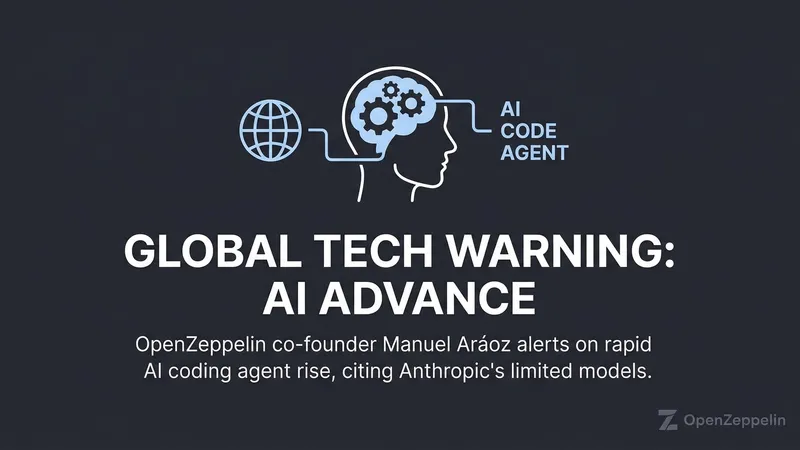
Crypto projects in the decentralized finance (DeFi) sector have faced a wave of security incidents lately, and now, one of the earliest figures in smart contract auditing has declared the entire DeFi space unsafe. This point of view was shared on X by Manuel Aráoz, co-founder of OpenZeppelin. He has gone so far as to privately advise friends and family to exit all DeFi positions, including what many view as low-risk “blue chips” such as Aave, MakerDAO, and Compound. Aráoz pointed to advances in artificial intelligence as the core reason for this shift in the reliability and trustworthiness of DeFi apps.
“Coding agents are superhuman at finding vulnerabilities, and smart contract security is too asymmetric: defenders need to fix every bug while attackers need just one exploit to steal funds,” he explained. Late last year, Anthropic released data showing AI agents had become far more capable at spotting and potentially exploiting bugs in crypto smart contracts. At that stage, the progress mostly involved issues humans had already identified. Things shifted earlier this year with the release of Anthropic’s Mythos model. The system is so powerful that Anthropic keeps it under tight restrictions and makes it available only to a limited group of partners. According to Anthropic, it has uncovered critical bugs in software that had run in production environments for decades without anyone noticing the flaws. Due to the security implications for the crypto space, exchanges, such as Coinbase, have reportedly reached out to Anthropic to gain access to Mythos.
To Aráoz’s point, a major DeFi hack last year sent a chill across the DeFi sector because it hit a vulnerability in a smart contract that had operated in the wild for years, survived multiple audits, and carried a reputation for being solid. The $120 million exploit itself played out in a way that echoed the penny-skimming scheme from the movie Office Space.
More recently, April stood out as the worst month on record for the sheer volume of crypto hacks, with incidents occurring at a pace of nearly one per day. North Korea has been linked to the vast majority of funds stolen through these attacks this year, though the regime issued a rare denial of involvement last month. Just this past weekend, another incident occurred when stablecoin issuer StablR saw its system compromised. The setup relied on a 1-of-3 multisignature wallet for minting, meaning a single key could approve actions, and an attacker gained control of one key, added themselves as administrator, removed the legitimate operators, and minted roughly $13.5 million in unbacked stablecoins. They swapped the tokens on decentralized exchanges and walked away with around 1,115 ether, valued near $3 million at the time.
As the StablR incident illustrates, the reality is that far from all hacks trace back to smart contract bugs. Social engineering and centralized attack vectors often play the decisive role, even in advanced protocols.
[AgentUpdate Depth Analysis] The security warning from OpenZeppelin’s co-founder highlights a brutal reality: AI agents are exponentially amplifying the asymmetry of cybersecurity. Traditional static auditing is obsolete against AI agents capable of continuous, autonomous reasoning. Anthropic’s Mythos model proves that adversarial agents can now systematically dismantle long-standing codebases. For the broader AI Agent ecosystem, this signals an urgent paradigm shift. We must move away from human-led, point-in-time audits toward 'Autonomous Defense Agents' capable of real-time monitoring, threat isolation, and self-healing. The future of decentralized protocols and critical software will be defined by millisecond-level skirmishes between offensive and defensive AI agents. Building resilient, agentic defense frameworks is no longer optional; it is the ultimate survival requirement for the next generation of digital infrastructure.