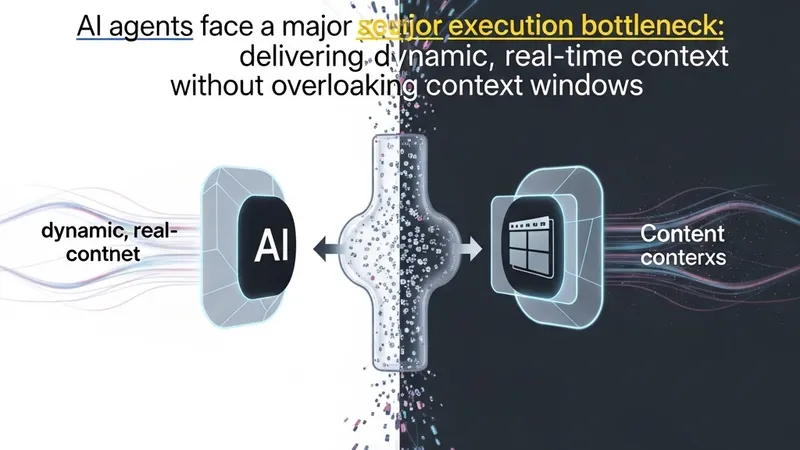
As Large Language Models (LLMs) evolve, AI is transitioning from passive conversational partners to autonomous agentic systems. However, as developers attempt to build agents capable of executing complex, real-world tasks, they are hitting a formidable bottleneck: the 'last mile' problem of delivering high-fidelity, dynamic, and real-time context to the agent at any given millisecond.
While modern models boast massive context windows—such as Gemini's 2 million tokens—stuffing entire databases or codebases into the prompt is highly impractical. This brute-force approach results in soaring API token costs, unacceptable latency, and the notorious 'lost in the middle' phenomenon where agents overlook crucial details. Furthermore, agentic tasks require stateful, dynamic context—such as active database records, user session states, and live API payloads—which static Retrieval-Augmented Generation (RAG) paradigms are ill-equipped to handle.
To solve this, developers are turning to 'Context Abstraction.' Rather than forcing an agent to interact directly with raw SQL databases, messy API structures, or unstructured log files, a context abstraction layer sits between raw data sources and the agent. This layer dynamically monitors, filters, prunes, and formats heterogeneous data into structured, semantically rich, and highly compressed context snippets tailored specifically for agent consumption, allowing the agent to focus purely on reasoning and planning.
This architectural shift has turned context abstraction into the latest developer battleground. A prime example is Anthropic's Model Context Protocol (MCP), an open standard designed to universalize how agents connect to data sources. Similarly, orchestration frameworks like LangChain and LlamaIndex are shifting their core value propositions from prompt engineering toward complex state and context orchestration, establishing the foundational plumbing for the agentic era.
[AgentUpdate Depth Analysis] Compared to traditional hard-coded API integrations, the emergence of 'context abstraction' and protocols like Anthropic's MCP represents a fundamental architectural pivot in AI: the separation of cognitive reasoning from environmental perception. Previously, developers relied on expanding context windows or brute-force vector search, which often led to high latency, 'lost in the middle' issues, and an inability to handle dynamic runtime states. A robust context abstraction layer acts as an intelligent gateway, optimizing token economy while giving agents a high-fidelity, real-time view of their environment. In the evolving AI Agent ecosystem, competitive advantage will shift from raw foundational model size to the efficiency and standardization of context abstraction pipelines, unlocking the true potential of multi-agent orchestration and production-ready automation.