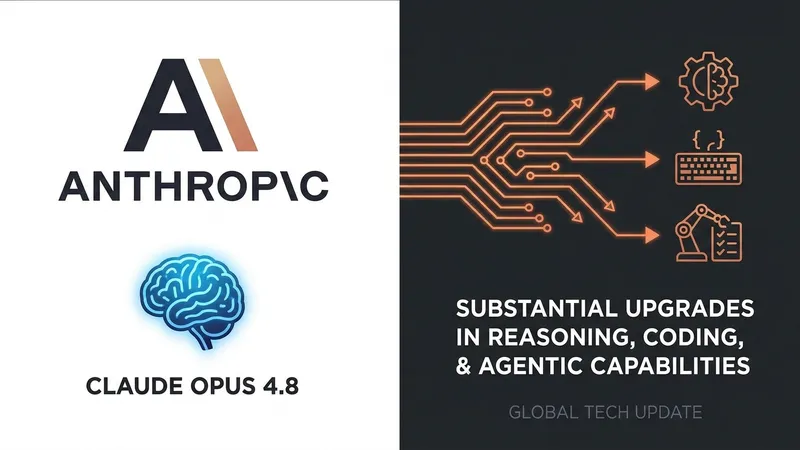
Anthropic has officially released Claude Opus 4.8, an upgrade to Claude Opus 4.7 that delivers enhanced performance in coding, agentic workflows, reasoning, and knowledge work. The model is now available via claude.ai, Claude Code, and the Claude API under the model identifier claude-opus-4-8.
Positioned specifically for coding and agent-driven workflows, Opus 4.8 excels at using tools within a context and performing self-verification. According to Anthropic, the model is four times less likely than its predecessor to pass flawed code without comment. Early feedback from testers, including those in software development, finance, and law, highlights its exceptional agentic capabilities. Notably, CursorBench tests revealed that Opus 4.8 requires fewer tool steps to achieve the same output quality. It also demonstrates lower deception rates, aligning closely with safety metrics of Claude Mythos Preview.
To help users manage the trade-off between quality, speed, and token burn, Anthropic introduced "Effort Control." Available on claude.ai and Cowork, users can adjust how much computation Claude applies. Opus 4.8 defaults to "high effort," which performs significantly better than Opus 4.7 while consuming a similar number of tokens on coding tasks. For highly complex tasks, users can select the "xhigh" setting. Anthropic has also increased Claude Code rate limits to accommodate the resulting higher token usage.
For massive codebases, Claude Code now features "Dynamic Workflows." This research preview feature plans workflows, spins up parallel sub-agents, verifies outputs, and reports back, enabling the migration of codebases containing hundreds of thousands of lines. This is currently available to Enterprise, Team, and Max plan subscribers.
On the API front, the Messages API now accepts real-time modifications to the messages array during execution. This allows developers to update instructions on the fly without breaking prompt cache structures or requiring additional user-interaction turns, significantly optimizing agent efficiency.
Pricing for Claude Opus 4.8 remains at $5 per million input and $25 per million output tokens in standard mode. The "fast mode" costs $10 per million input and $50 per million output tokens, delivering a 2.5x speed boost over standard operations.
[AgentUpdate Depth Analysis] The release of Claude Opus 4.8 underscores Anthropic’s strategic focus on transforming LLMs from standalone assistants into core engines for multi-agent systems. Rather than focusing solely on raw benchmark scores, the architectural improvements in Opus 4.8 directly address the bottlenecks of real-world Agent deployment. The dynamic sub-agent workflows in Claude Code mark a transition from linear reasoning to parallel execution and self-auditing. Furthermore, by allowing real-time edits to the Messages API without breaking Prompt Caching, Anthropic has solved a critical cost-and-latency bottleneck for stateful Agents. While competitors push toward monolithic "black-box" reasoning models, Anthropic's approach offers granular control over reasoning effort and execution pathways. This pragmatism will accelerate the deployment of highly reliable, cost-efficient, and complex AI Agents across enterprise developer toolchains.