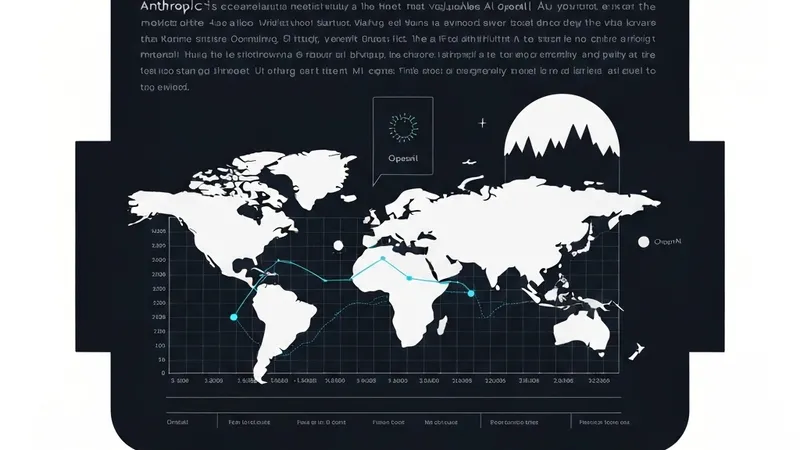
In a historic shakeup at the summit of the generative AI landscape, Anthropic has reportedly overtaken its fierce rival OpenAI to become the world's most valuable AI startup. This momentous valuation surge, driven by recent private funding rounds and highly active secondary market trading, marks a critical inflection point where technical reliability and developer-centric ecosystems are reshaping the industry hierarchy.
While OpenAI has navigated a turbulent period marked by high-profile executive departures and complex commercial restructuring, Anthropic has maintained a laser-sharp focus on engineering excellence and safety alignment. The release of Claude 3.5 Sonnet proved to be a decisive turning point, consistently outperforming GPT-4o across industry benchmarks in coding, reasoning, and enterprise-grade tasks, thereby securing massive corporate adoption.
Anthropic's strategic funding structure has also played a crucial role in its ascension. Backed by multi-billion dollar commitments from tech giants like Amazon and Google, the company has secured vast computational resources while avoiding a single-cloud lock-in. Furthermore, Anthropic's recent launch of the Model Context Protocol (MCP) has established an open standard for connecting AI models to data sources, galvanizing the global developer community and rapidly expanding its enterprise footprint.
[AgentUpdate Depth Analysis] Anthropic’s rise to the top signals a critical paradigm shift in the AI Agent ecosystem. While OpenAI has historically dominated market mindshare with consumer-facing products, its closed, portal-centric approach has created friction for complex agentic workflows. Anthropic has successfully capitalized on this gap by aligning the Claude 3.5 series with developer-first frameworks, highlighted by pioneering features like "Computer Use" and the open-source Model Context Protocol (MCP). By establishing standardized, secure, and bidirectional communication layers between LLMs and external enterprise databases, Anthropic is building a more resilient, interoperable foundation for autonomous agents. This strategy directly challenges OpenAI's closed API dominance, accelerating the transition of the entire AI sector from simple chatbots to highly integrated, multi-agent orchestration systems that seamlessly interact with real-world infrastructure.