Huawei Unveils "Tao Law" to Redefine Chip Design, Kirin 2026 Expected in Mate 90
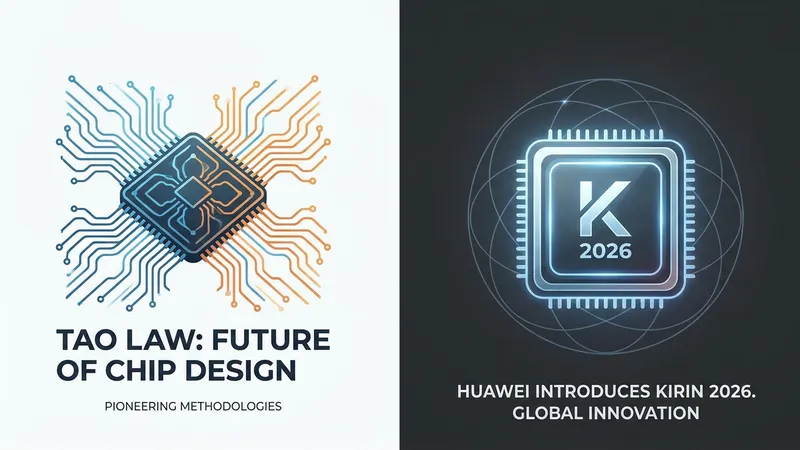
At the 2026 International Symposium on Circuits and Systems (ISCAS) in Shanghai, Huawei Technologies Co. board member and president of the semiconductor business unit, He Tingbo, officially announced the "Tao (τ) Law." This breakthrough is hailed as China's first new guiding principle for global semiconductor industry development. Huawei stated that based on this law, it has successfully designed and mass-produced 381 chip models over the past six years.
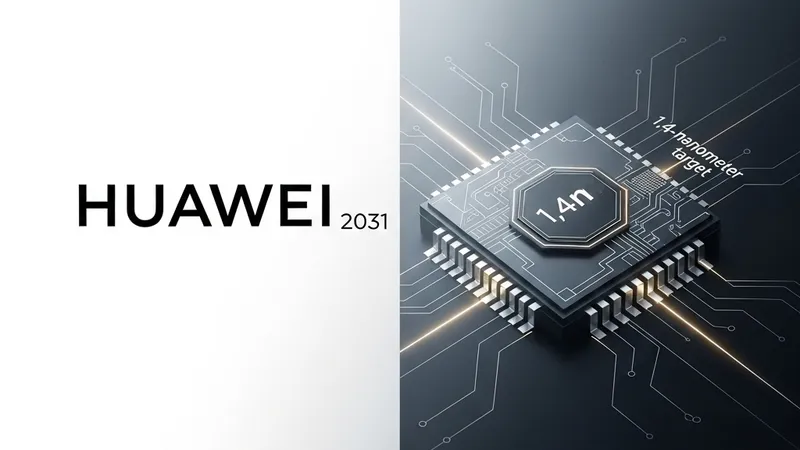
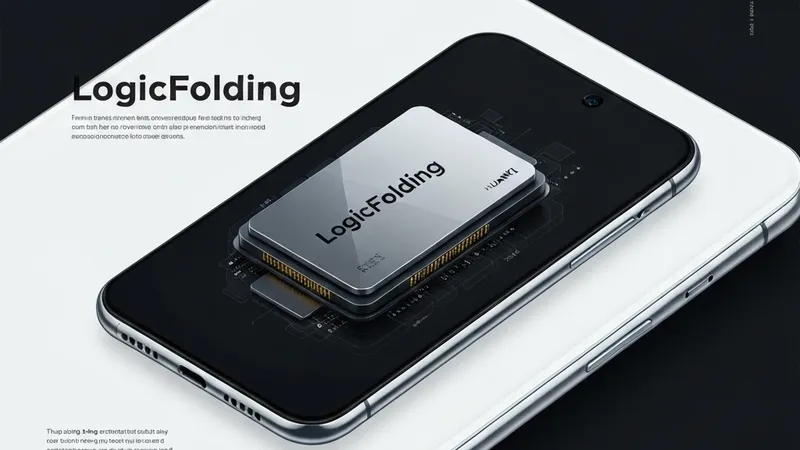
The "Tao Law" centers on replacing traditional "geometric miniaturization" with "time miniaturization," aiming to systematically reduce the time constant (τ). Through innovative techniques like "logic folding," it seeks to continuously compress signal propagation delay while simultaneously increasing transistor density, thereby driving the sustained evolution of semiconductor and electronic systems. Huawei projects that by 2031, high-end chips designed under this law could achieve transistor densities equivalent to those of a 1.4-nanometer process.
Notably, He Tingbo revealed that the Kirin 2026 chip, set to launch this autumn, will be the first to fully incorporate "logic folding" technology. The Huawei Mate 90 series is expected to be the first to feature this next-generation chip. She emphasized that the future of the semiconductor industry lies in open collaboration, with Huawei looking forward to working closely with global partners to advance the industry.
DeepSeek Tops Global AI Model Call Rankings, Highlighting Chinese Model Strength
According to the latest data from the OpenRouter platform, global AI large language model call volume reached 28.9 trillion tokens between May 18 and May 24, marking a 7.4% week-over-week increase and the fifth consecutive week of growth. Chinese AI models recorded 9.22 trillion tokens in weekly call volume, up 19.89% week-over-week, surpassing U.S. models (4.93 trillion tokens, up 16.27%) for the fourth consecutive week. DeepSeek-V4-Flash notably claimed the top spot on OpenRouter's global call ranking.
Embodied AI Sector Heats Up: Unitree Robotics Nears IPO, Tianji Intelligent Secures Major Investment
Caixin reports that Unitree Robotics, a domestic humanoid robotics company, is scheduled for its IPO review on June 1, just 73 days after its application was accepted. The offering is expected to value the company at no less than 42 billion RMB. Unitree Robotics achieved profitability in 2024, with revenue increasing to 1.167 billion RMB and net profit reaching 105 million RMB in the first three quarters of 2025 (assuming original text intended 2024 or a projection). Humanoid robotics has emerged as a significant growth driver. The company, initially known for its quadruped robots, is increasingly focusing on humanoids, motion control, and its developer ecosystem.
Concurrently, robotics firm Tianji Intelligent recently secured 1 billion RMB in funding, with Meituan and Tencent among the investors. This investment further highlights the surging interest and activity in the embodied AI sector in China.
Menbuchi Intelligent Open-Sources 1.58-bit Edge Large Model BitCPM-CANN
Innovation continues in the AI landscape as Menbuchi Intelligent announced the open-sourcing of its 1.58-bit edge large model, BitCPM-CANN. This development further promotes the advancement of lightweight and efficient AI models for edge computing applications.
Luxshare Precision Advocates Optical-Copper Synergy for AI Server Interconnects
Luxshare Precision, at its annual shareholders' meeting, stated its long-term commitment to a "co-advancement of optical and copper" strategy, asserting that both optical and copper interconnects will coexist for the foreseeable future. This approach is not contradictory to leading clients' investments in optical chips and fibers. The company noted that while future product services will see significantly higher demand for optical connections, copper connections still possess high technical thresholds. These two routes are suited for different distance and speed scenarios: copper for short distances, and optical for longer distances and higher data rates, especially when copper reaches its signal transmission limits. This strategy aims to meet the escalating interconnect demands of AI servers and data centers, adapting to advancements by clients like Nvidia in optical chips, fibers, and high-speed interconnect ecosystems.
Galaxy Securities: Sodium-Ion Batteries Nearing Mass Commercialization
According to a Galaxy Securities research report, CATL's announcement of planned mass production for its new sodium-ion batteries in Q4 this year signals a clearer path to mass validation for the sodium-ion battery industry chain. The report identifies automotive power, energy storage, and two-wheel vehicles as key growth areas. Sodium batteries, with their wide operating temperature range and cost-effectiveness, can improve EV performance in cold weather. Their high safety and discharge power suit certain stationary energy storage needs. For two-wheelers, they offer a low-cost alternative to lead-acid batteries. Galaxy Securities forecasts sodium-ion battery shipments to reach 25 GWh, 92 GWh, and 221 GWh in 2026, 2027, and 2028, respectively, potentially exceeding 600 GWh by 2030.
Gurman: Apple Watch Needs a Health Narrative Reboot
Bloomberg's Mark Gurman stated in his PowerOn newsletter that the Apple Watch faces increasing direct competition from health wearables like Whoop, Oura, and Fitbit. Apple needs to reassess its product rhythm for the Watch and its health business. While the Apple Watch has expanded from notifications and fitness tracking to include heart rate, sleep, hearing aid functions, and fall detection, recent hardware updates have been minor, failing to create a clear growth narrative for new health sensors and service capabilities. Gurman suggests Apple needs tighter integration between hardware, software, and health services to remain competitive in the evolving health wearable market.