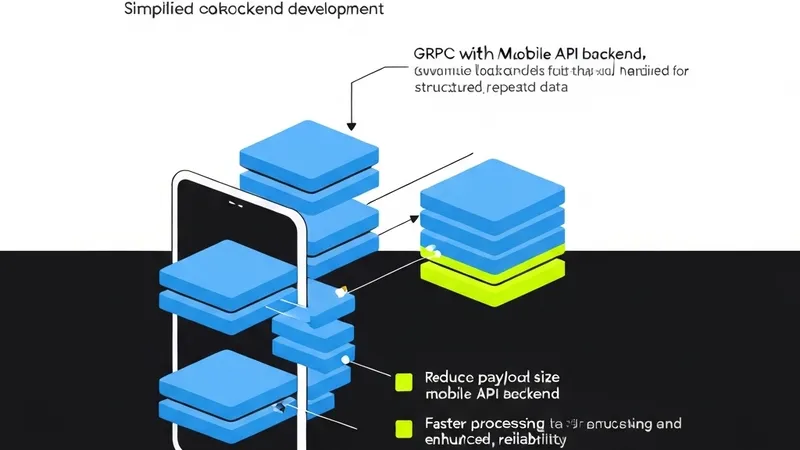
Choosing the right communication protocol is paramount for mobile API backend development. gRPC, combined with Protocol Buffers, presents distinct advantages and tradeoffs compared to traditional REST+JSON in terms of performance, efficiency, and developer experience. This article delves into the real-world performance of gRPC versus REST on mobile, examines the inherent tradeoffs, and offers practical guidance.
Key findings indicate that for structured and repeat-field-heavy data payloads, gRPC with Protocol Buffers can reduce payload size by approximately 60% and accelerate serialization speeds on mobile devices by 30-40%. However, for simpler CRUD (Create, Read, Update, Delete) operations, the overhead associated with HTTP/2 connection setup and the Protobuf toolchain complexity might negate these performance gains. The true game-changer for gRPC lies in its "schema-first" design philosophy and cross-platform code generation capabilities, which fundamentally eliminate a significant class of integration bugs across Android, iOS, and KMP teams.
Design Philosophy: Start With the Schema
Many teams adopting gRPC often perceive it primarily as a wire format optimization. However, it is fundamentally a design discipline. By defining your .proto files before writing a single line of Kotlin or Swift, developers are compelled to think precisely about field types, API evolution strategies, and the exact promises of their API. Treating .proto schemas as the canonical contract is the foundational step for building robust systems.
Understanding Where Binary Format Truly Excels
Below are representative benchmarks from mid-range devices (such as Pixel 6a, iPhone SE 3rd gen) serializing a typical "order list" response containing 50 items:
| Metric | REST + JSON | gRPC + Protobuf | Delta |
|---|---|---|---|
| Payload size (wire) | 48.2 KB | 18.7 KB | -61% |
| Serialization (Android, median) | 12.3 ms | 7.1 ms | -42% |
| Deserialization (Android, median) | 14.8 ms | 9.2 ms | -38% |
| Serialization (iOS, median) | 10.1 ms | 6.8 ms | -33% |
| Deserialization (iOS, median) | 11.6 ms | 7.9 ms | -32% |
| Simple single-object GET | 0.4 KB | 0.3 KB + framing | ~negligible |
These benchmarks illustrate that the performance advantages of binary formats scale with payload complexity. For instance, fetching a single user profile might be perfectly fine with JSON. However, for a paginated feed with nested objects, gRPC's benefits become significantly more pronounced.