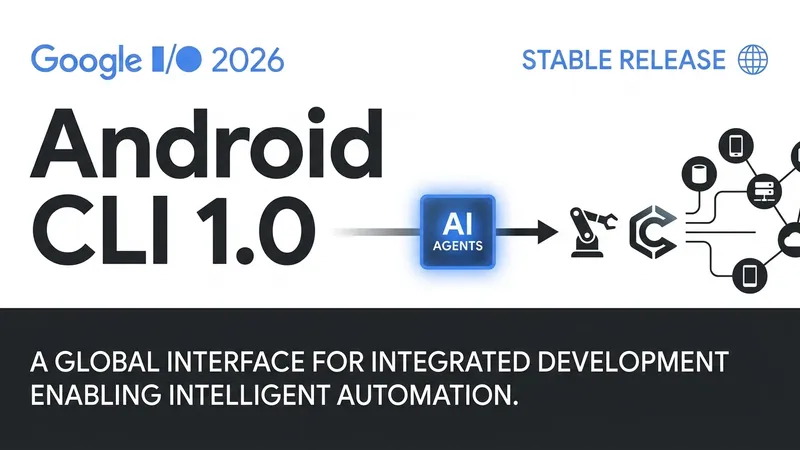
At its annual Google I/O developer conference, Google announced that its Android CLI (command line interface) is now stable at version 1.0. This new toolset is designed to empower developers leveraging AI agents to accelerate Android app development, regardless of their preferred coding platform.
The launch acknowledges a shifting landscape: many developers are now building for Android using third-party AI agents, such as Claude Code, OpenAI's coding tools, alongside Google's own Antigravity or Gemini in Android Studio. By releasing Android CLI, Google aims to make its proprietary specialized knowledge, historically locked inside Android Studio, far more accessible to external agentic workflows.
With the new Android CLI, AI agents can retrieve deep knowledge about Android development via a new "android studio" command, tapping directly into the capabilities of Android Studio during the project build process. From there, these agents can utilize a wide range of other commands and utilities. Additionally, Google's agentic development platform, Antigravity, will feature an optional bundle to install the tools and knowledge packaged in Android CLI, enabling it to perform core Android development tasks autonomously.
[AgentUpdate Depth Analysis] The release of Android CLI 1.0 marks a critical transition from "human-centric" developer tools to "agent-centric" infrastructure. Historically, complex development ecosystems like Android—with its intricate Gradle build systems and highly specialized Android Studio environment—posed significant hurdles for generic coding agents like Claude Code or Cursor due to the lack of low-level, structured environment access. By exposing Android Studio's core capabilities via a standardized CLI, Google is effectively providing AI agents with "first-class citizen" access to the SDK compile and build pipelines. This strategic decoupling of the IDE's intelligence into a machine-readable CLI represents a massive paradigm shift. Compared to traditional SDK wrappers, this move establishes a direct API loop between AI cognitive reasoning and native execution. It sets a new standard for how platform gatekeepers must adapt their developer ecosystems, paving the way for autonomous AI agents to manage end-to-end app lifecycles, from generation to compilation and debugging.