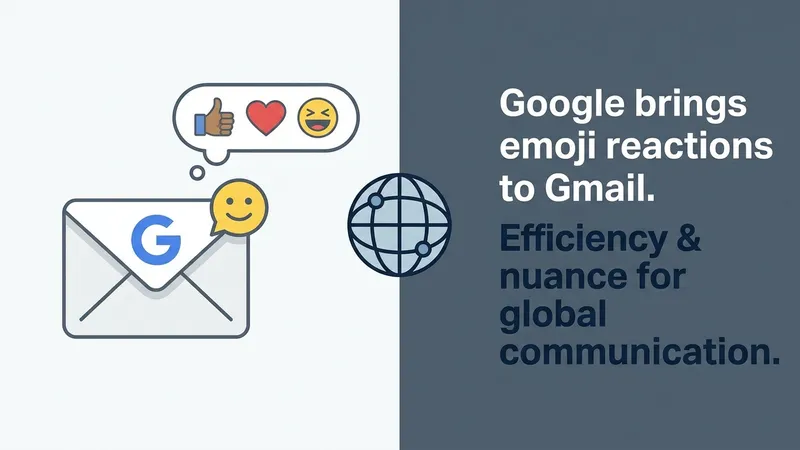
Google is set to enhance Gmail with emoji reaction capabilities, a development poised to significantly streamline and humanize digital correspondence. This upcoming feature closely mirrors the instant, visual acknowledgment methods prevalent in modern chat applications, where users can append a quick emoji—such as a thumbs-up or a laughing face—directly to a message to convey immediate sentiment or confirmation.
The profound utility of these in-text emojis, often recognized as "tapbacks" on platforms like Apple's iMessage, stems from their remarkable efficiency and versatility. A single, well-placed emoji can encapsulate a range of contextual responses. For instance, a simple "thumbs-up" might signify "Gotcha," "Agreed," "We're good," "Acknowledged," or even "See you there." Similarly, a "ha-ha" emoji swiftly communicates amusement without requiring a full textual reply. This brevity provides a non-verbal cue that frequently gets lost in traditional digital communication but is fundamental to in-person interactions, thereby enriching the overall conversational context and making interactions feel more intuitive.
Integrating such concise and expressive acknowledgments into the email platform is expected to yield substantial benefits for asynchronous communication. It empowers recipients to instantly signal receipt, express agreement, or offer a quick reaction, consequently reducing the necessity for numerous short, often redundant, textual email replies. This not only significantly boosts efficiency by minimizing typing time and reducing inbox clutter but also injects a vital layer of human nuance, making digital exchanges feel more engaging and less purely transactional. By adopting this widely accepted communication paradigm for email, Google aims to make professional correspondence both more efficient and distinctly more human-centric.