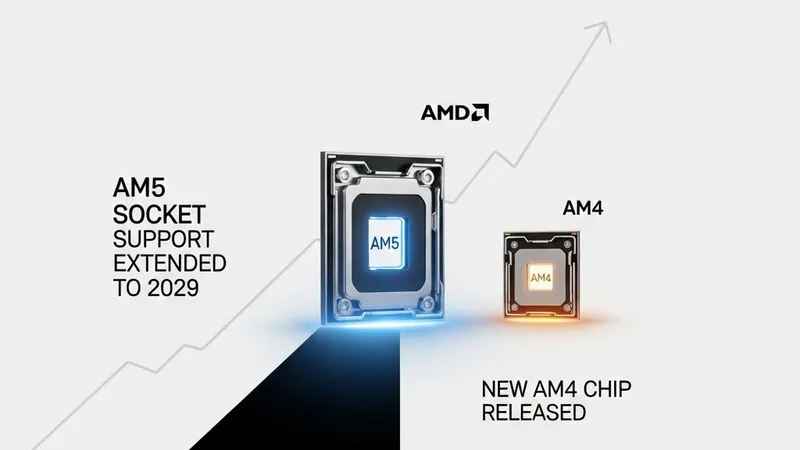
At Computex, AMD officially announced the extension of its current AM5 socket support through at least 2029. This decision reaffirms AMD's historic advantage over Intel in motherboard longevity, allowing users to perform multiple CPU upgrades without the need to replace their foundational platforms or RAM kits.
Beyond the AM5 extension, AMD is breathing new life into the decade-old AM4 platform. The company is re-releasing the Ryzen 7 5800X3D, branded as a “10th Anniversary Edition,” featuring its signature 3D V-Cache technology. While the chip may lag in general productivity benchmarks compared to newer 8-core CPUs, its 64MB of additional L3 cache significantly bolsters gaming performance. This offers a compelling upgrade path for users looking to pair modern high-end GPUs with legacy AM4 boards, avoiding common performance bottlenecks. The chip is scheduled for release on June 25, priced at $349.
By shifting the roadmap from 2025 to 2029, AMD is directly addressing the escalating costs of PC building and major component upgrades. This strategic move aims to retain the enthusiast DIY base by offering a longer return on investment for their platform ecosystem.
[AgentUpdate Depth Analysis] AMD’s commitment to platform longevity offers profound implications for the evolving AI Agent ecosystem. In an era where AI compute requirements are accelerating, the standardization and compatibility of underlying hardware serve as a critical catalyst for large-scale Agent deployment. Similar to the role of standardized protocols like MCP in software, AMD’s 'long-term support' philosophy builds a stable hardware foundation. For developers running AI Agents locally, this consistency ensures that deployment environments remain viable, significantly lowering the migration costs associated with architectural churn. As AI Agents transition from cloud-native to edge-capable systems, balancing compute performance with infrastructure stability will be a defining challenge for both chipmakers and edge-computing frameworks. By extending its platform lifecycle, AMD is effectively securing the infrastructure necessary for future localized AI Agent workloads. This hardware-level resilience parallels the benefits of software interface standardization, providing a robust bedrock for the next generation of autonomous AI Agents.