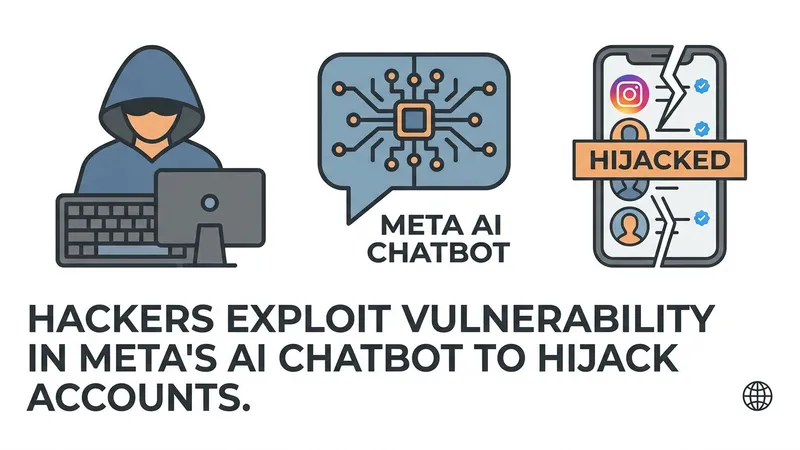
Meta confirmed on Monday that hackers exploited a vulnerability in its AI-powered support chatbot to infiltrate high-profile Instagram accounts. According to 404 Media, the victims included Barack Obama’s official White House account, Sephora, and the Chief Master Sergeant of the U.S. Space Force. Similar incidents were reported by regular users across Reddit and X throughout the weekend.
Security researchers and hacker groups shared tutorials on Telegram demonstrating the exploit. Evidence showed attackers prompting Meta’s AI assistant to link a target account to a new, attacker-controlled email address. The AI bot verified that a security code was sent to the new email and prompted the hacker to input the code within the chat interface. Upon success, the bot granted access to a password reset button. In some cases, attackers utilized VPNs to spoof location data and bypass Meta’s standard security safeguards.
Meta stated, "This issue has been resolved, and we are securing impacted accounts," though the company remained silent on the exact scope of the breach. This incident has sparked a significant debate over the safety of relying on AI models for critical security procedures like account recovery.
Meta’s AI support assistant, launched earlier this year to handle reporting scams, impersonation, and password resets, was intended to streamline user support. However, the breach underscores the danger of granting high-level API execution privileges to automated models without sufficient authorization verification or robust guardrails.
[AgentUpdate Depth Analysis] This security breach serves as a stark warning for the AI Agent ecosystem, highlighting the critical gap between automated execution and robust authorization logic. As AI Agents transition from passive information retrieval to active system control—acting as a 'System-as-an-Agent'—the lack of deterministic verification pathways becomes a liability. Much like the injection vulnerabilities seen in frameworks like LangChain, Meta's incident proves that LLMs cannot serve as the sole gatekeepers of sensitive operations. Future Agent architectures must prioritize a "Human-in-the-loop" verification model and strict API policy guardrails to decouple decision-making from high-privilege execution. If platforms continue to bundle powerful system-level actions within conversational interfaces without layered identity assurance, the convenience of AI agents will inevitably lead to systemic, scalable security collapses. Developers must treat agentic workflows not just as a feature expansion, but as a high-stakes security surface that requires rigorous, rule-based verification protocols beyond the stochastic nature of large language models.