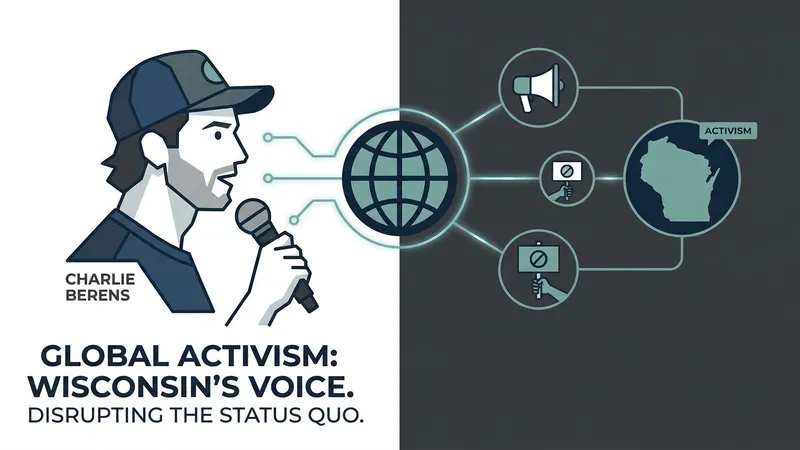
Last summer, Wisconsin-based comedian Charlie Berens began receiving numerous messages from his audience regarding plans for a massive datacenter project in their local community. Upon investigating the issue, Berens was struck by the significant and largely overlooked consequences these facilities impose on local residents, ranging from resource strain to environmental disruption.
Choosing to use his platform for advocacy, Berens produced a satirical video that went viral, effectively translating complex infrastructure issues into accessible content for the general public. His work has since evolved beyond mere commentary; he has become an active voice on the frontlines of grassroots opposition against the unchecked expansion of hyperscale datacenters. Berens argues that there is a significant lack of negotiation and transparency, with large tech entities often steamrolling local concerns in their pursuit of AI-driven compute capacity.
[AgentUpdate Depth Analysis] Berens’ activism serves as a critical case study for the AI Agent ecosystem, illustrating the growing friction between accelerated digital infrastructure and local community sovereignty. As we move deeper into the era of specialized AI Agents—which demand significantly higher compute density and energy throughput—the physical footprint of these operations is becoming a flashpoint for social resistance. Unlike the cloud computing era, the AI-first model requires massive localized GPU clusters that challenge existing power grids and local environmental standards. When compared to the early days of ISP expansion, the stakes today are far higher due to the sheer scale of energy consumption. The long-term trajectory of the AI Agent industry will not only be defined by latency and accuracy but by its social license to operate. If tech providers fail to integrate sustainable, transparent, and community-conscious infrastructure planning, they risk triggering a global wave of regulatory pushback that could stall hardware deployments and fundamentally alter the growth trajectory of AI agentic workflows.