Chinese technology giant Alibaba introduced a new self-developed AI chip on Wednesday, marking its latest move to reduce dependency on Nvidia GPUs and advance its full-stack AI strategy.
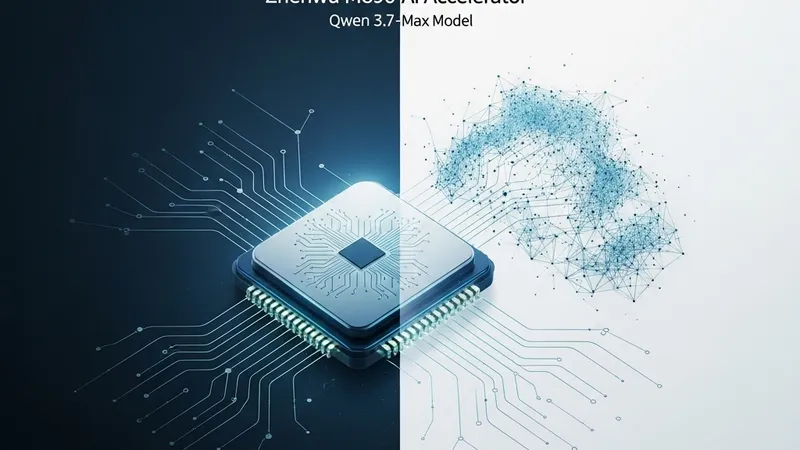
Unveiled at the Alibaba Cloud Summit, the Zhenwu M890 is a training-and-inference-integrated accelerator designed by T-Head, Alibaba’s specialized semiconductor division. Crucially, Alibaba has explicitly built and optimized this processor for AI agents. The chip is engineered to address the massive memory demands of long context windows and the intricate communication workloads generated by multiple AI models interacting with one another.
Alongside the hardware release, the vendor showcased its updated Qwen 3.7-Max LLM, which has been optimized to run seamlessly on the M890 for up to 35 hours of continuous processing. According to Alibaba, Qwen 3.7-Max can perform long-horizon continuous reasoning and manage more than 1,000 tool calls. It is tailored for complex tasks such as multi-file code editing, system refactoring, and rapid prototyping, all powered by a massive 1-million-token context window.
[AgentUpdate Depth Analysis] Alibaba's positioning of the Zhenwu M890 as a chip customized for AI agents signals a pivotal shift in the AI hardware landscape from generic compute density to workload-specific acceleration. The core operational bottlenecks of Agentic AI lie in the high-frequency communication overhead of multi-agent systems and the intensive memory pressure of expanded context windows. By optimizing memory and interconnects at the silicon level, the M890 directly addresses these bottlenecks, significantly lowering latency and cost. When coupled with Qwen 3.7-Max, Alibaba establishes a formidable software-hardware co-design paradigm. This vertical integration not only mitigates the geopolitical risks of Nvidia supply dependency but also provides a blueprint for the next generation of industrial-grade Multi-Agent ecosystems, paving the way for autonomous workflows that require sustained, reliable, and cost-efficient reasoning.