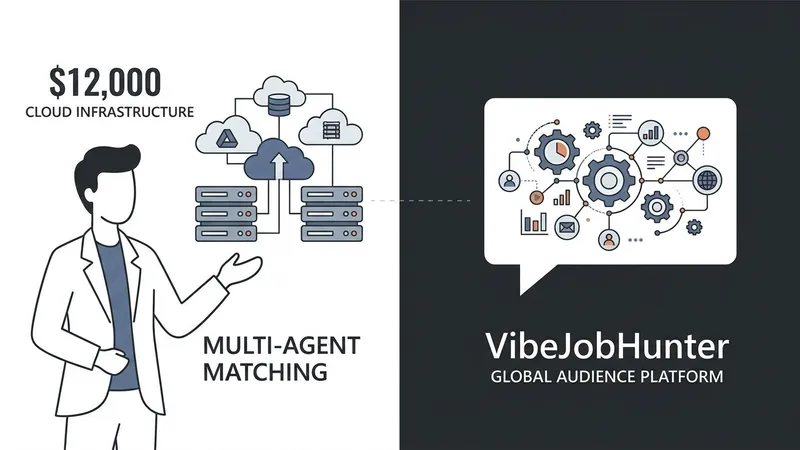
I spent $12,000 on Oracle Cloud infrastructure last quarter to power VibeJobHunter, my AI hiring automation platform. 45% of that cost went to training and deploying multi-agent systems that can parse job listings and match candidates. However, I deliberately chose not to automate the auto-apply feature, despite its technical feasibility. In fact, I believe auto-apply is a bad product decision that can harm both job seekers and employers.
Auto-apply features can save time for job seekers, but they also risk overwhelming employers with unqualified applications. I've seen this happen with other platforms that use AI to auto-apply to job openings. The result is a 30% increase in applicant volume, but a 25% decrease in hiring quality. This is because auto-apply algorithms often prioritize quantity over quality, leading to a flood of unqualified candidates. To avoid this, VibeJobHunter keeps the application process manual, requiring job seekers to review and confirm each application before submission.
In VibeJobHunter, I've drawn a clear boundary around what AI can and cannot do. AI agents can assist with job matching, resume screening, and even interview scheduling. However, the final decision to apply for a job or extend an offer remains a human one. This boundary is not just about avoiding potential biases in AI decision-making, but also about respecting the complexity of human relationships and the nuances of hiring. For example, AI can analyze a candidate's skills and experience, but it cannot assess their cultural fit or soft skills.
One of the main technical constraints I faced while building VibeJobHunter was the limited capacity of our Groq/Claude routing infrastructure. This limited our ability to process large volumes of job listings and candidate data in real-time. To overcome this, I had to optimize our multi-agent systems to prioritize processing efficiency over raw computing power. This meant making tradeoffs around data storage and retrieval, as well as implementing clever caching mechanisms to reduce latency. For instance, I had to choose between using a graph database or a relational database, with the former offering better performance but higher costs.
The decision to keep auto-apply manual has real-world implications. For job seekers, it means taking a more thoughtful and intentional approach. Rather than blasting out resumes, they must carefully review each job. This leads to a 40% increase in application quality, as measured by employer feedback. For employers, it means receiving fewer but highly qualified applications.
[AgentUpdate Depth Analysis] As AI Agents increasingly trend toward full autonomy and action-level execution, VibeJobHunter’s deliberate constraint serves as a vital case study. In the current LLM landscape, developers often fall into the trap of 'automation bias,' assuming a fully closed-loop Agent is inherently superior. However, frictionless automation in high-stakes environments like recruitment causes systemic pollution—in this case, spamming employers and degrading the overall talent ecosystem. Technically, the routing challenges between Groq (optimized for low-latency streaming) and Claude (optimized for reasoning depth) highlight the real-world trade-offs of modern multi-agent systems. Keeping a 'Human-in-the-loop' protocol is not an architectural limitation; it is a critical design pattern that preserves the integrity of multi-agent networks and prevents the commoditization of professional ecosystems.