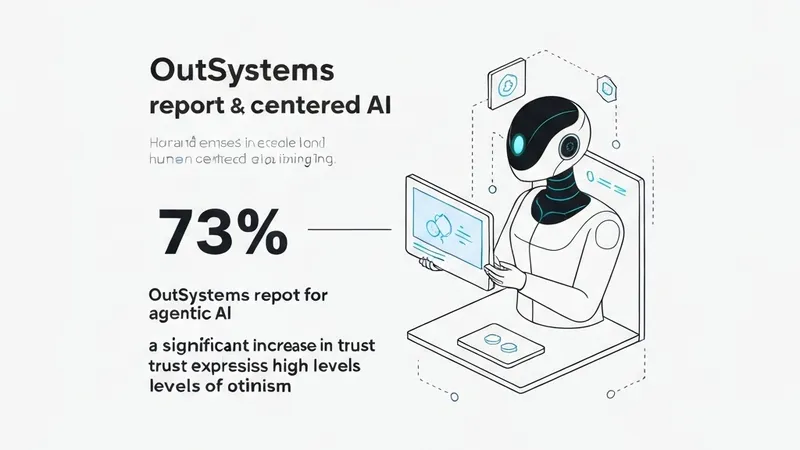
A recent report by OutSystems indicates a growing trust in agentic AI. According to the findings, 73% of respondents express either high or moderate trust in allowing AI agents to operate autonomously, marking an approximate 10% increase compared to a similar survey conducted by the company last year. Trust in code or workflows generated by third-party AI tools also saw a substantial rise, reaching 67%, significantly up from the prior year’s figure of only 40% who ‘mostly trusted’ generative AI to write code without human intervention.
Despite increased trust, the implementation of centralized AI governance remains a challenge. Only 36% of respondents reported having a centralized approach to AI governance, while 64% acknowledged lacking such a facility, with 41% relying on rules implemented on a per-project basis. The report also highlights that two-thirds of respondents find building human-in-the-loop (HITL) checkpoints technically difficult. This complexity stems from the need for orchestration capabilities that can effectively pause agents, thereby inserting manual braking into potentially fully autonomous operations.
Many organizations appear to be adopting looser oversight models. The report's authors caution that if this trend continues, the adoption of agentic AI might advance more rapidly than the development of crucial accountability methods. For firms aiming to scale agents in regulated or mission-critical environments, the survey findings emphasize the importance of treating orchestration and auditability as integral parts of the product. When compliance checks evaluate a business’s operations, essential elements for any agentic AI rollout include traceable "breadcrumb trails" in the form of logfiles and clearly defined responsibilities.
Furthermore, the report reveals widespread concern about "AI sprawl." Although not explicitly defined, 94% of leaders expressed concern over this phenomenon, which can be inferred as a lack of a centralized management platform overseeing all enterprise AI deployments. Of these, 39% are very or extremely concerned. Currently, only 12% of organizations are utilizing a centralized platform to manage and control this sprawl effectively.