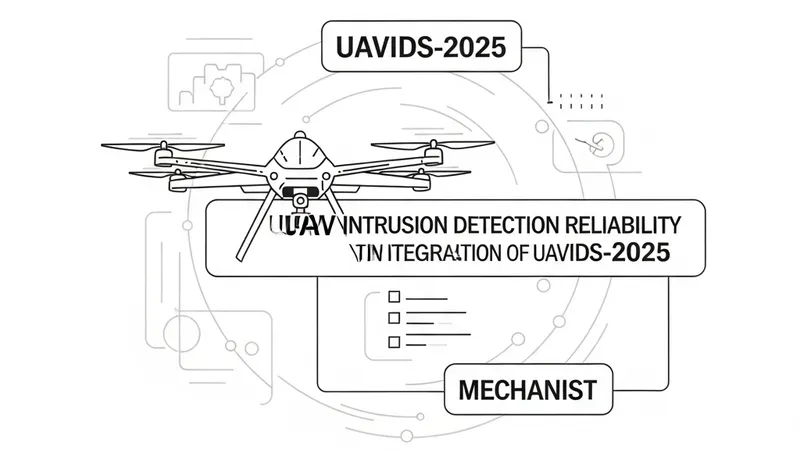
In recent years, Mechanistic Interpretability, a specialized subfield under the umbrella of Explainable Artificial Intelligence (XAI), has been introduced to explain the complex decisions made by machine learning models in critical domains such as UAV Intrusion Detection Systems (UAVIDS). The latest paper, "XAI and Statistical Analysis for Reliable Intrusion Detection in the UAVIDS-2025 Dataset: From Tree to Hybrid and Tabular DNN Ensembles," proposes a rigorous, statistics-driven methodology to tackle these security challenges.
The researchers applied best practices for data pre-processing and thoroughly examined a wide range of ML paradigms—including tree-ensembles, deep neural networks (DNNs), hybrid stacking models, and state-of-the-art tabular ensemble neural networks—using stratified 10-fold cross validation. Among these models, XGBoost achieved top-performing results and was selected as the backbone for further interpretability analysis.
To demystify the model's inner workings, the team utilized Shapley Additive explanations (SHAP) to dissect both global and local feature importances. This analysis revealed exactly how specific cyberattacks manipulate packet and network features to mimic normal traffic, while pointing out precisely where misclassifications occurred. A detailed distribution analysis followed, visually comparing violin plots and Kernel Density Estimation (KDE) curves to capture complex anomalous patterns.
By incorporating the Westfall-Young permutation test for multiple comparisons, optimizing the bandwidth of the KDEs, and selecting the Jensen-Shannon Distance for the test, the researchers successfully diagnosed the root causes of false predictions observed in highly elusive Wormhole and Blackhole attacks within the UAVIDS-2025 dataset. The findings effectively address the "Density Support Intersection" challenge, providing robust, reliable, and highly explainable models for aerial security along with deep statistical insights that clarify the masked nature of modern cyber threats.
[AgentUpdate Depth Analysis] As AI Agents increasingly shift from digital environments to physical deployment in UAV swarms and robotic networks, securing their underlying communication and consensus protocols becomes a primary challenge. This paper highlights how combining Mechanistic Interpretability (XAI) with rigorous statistical metrics can move beyond simple post-hoc explanations to build a proactive defense. In future multi-agent ecosystems, agents must possess autonomous self-explanation capabilities. By embedding SHAP and Jensen-Shannon distance diagnostics directly into the Agent's runtime environment, an Agent swarm can not only detect sophisticated Wormhole or Blackhole attacks but also comprehend the attacker's tactical intent. This adaptive intelligence enables autonomous agents to dynamically reconfigure network topologies and secure communication policies in real-time, bridging the gap between passive anomaly detection and fully resilient, self-healing cyber-physical Agent systems.