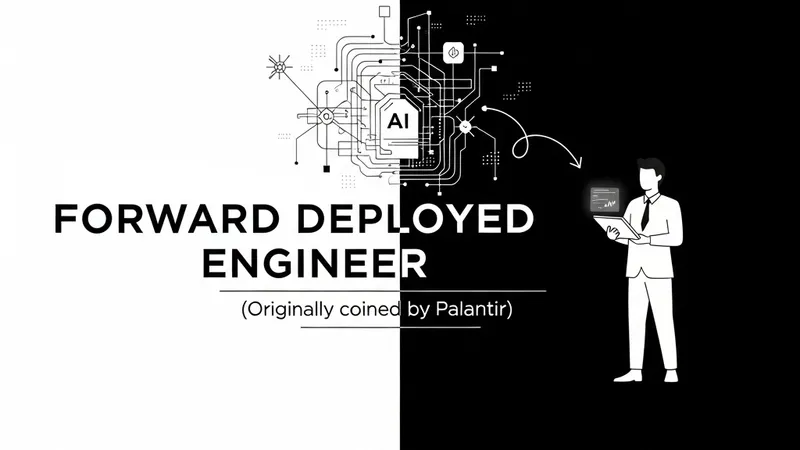
The term ‘Forward Deployed Engineer’ (FDE) sounds military. That is intentional.
A Forward Deployed Engineer is a software engineer who works embedded with the customer’s technical and operational environment on-site, hybrid, remote, or inside a customer cloud or VPC, depending on the engagement. The FDE does not sit at a home office writing documentation. The FDE works alongside the client’s domain experts, inside the client’s workflows, and writes real code that runs in the client’s production systems.
The role differs from traditional advisory consulting because FDEs own implementation and production delivery. Consultants write reports and recommendations; an FDE builds the actual system and stays until it runs in production. The role was coined by Palantir in the early 2010s, and it emerged from a problem Palantir could not solve any other way.
The Origin: Palantir’s Intelligence Agency Problem
Palantir was founded in 2003 to help U.S. intelligence agencies make sense of large, fragmented datasets. The problem was not purely technical.
Intelligence agencies could not clearly describe what they needed. They could not openly share their data. Their workflows changed constantly. A traditional software product could not keep up. Palantir’s engineers had to go inside the agencies and work out the problem on-site. These early on-site engineers were called ‘Deltas.’
Until 2016, Palantir had more FDEs than software engineers. That ratio is unusual by software company standards. It shows how central the embedded model was to the business from the start.
The FDE role was inspired by how high-end French restaurants operate. The front-of-house staff is deeply integrated with the kitchen. They are empowered to tell customers ‘no’ if the customer is ordering incorrectly. Palantir applied that same philosophy to enterprise software delivery.
Why Standard SaaS Does Not Work for Complex AI Deployments
To understand why the FDE model is trending now, you need to understand where the standard SaaS model breaks down.
The standard enterprise software motion looks like this: A company builds a product; the sales team pitches it to clients; a customer success manager helps with onboarding; and the client’s internal team integrates it. This works for well-understood products like a CRM, a project management tool or an analytics dashboard. These have documented APIs, predictable behavior, and large communities who share implementation patterns.
AI systems break this model because there is a knowledge gap on both sides.
The client’s engineers know their business deeply: the data schemas, the compliance requirements, the edge cases, and the legacy system architecture. The AI lab’s engineers know how models behave in production: the prompting patterns, the retrieval-augmented generation (RAG) strategies, the evaluation frameworks, and the failure modes that appear only at scale. Neither side has the other's knowledge, which is why FDEs are needed to bridge the gap.
[AgentUpdate Depth Analysis] The rise of Forward Deployed Engineers (FDEs) underscores a critical reality in the AI Agent ecosystem: standardized SaaS delivery models fall short when tackling complex, domain-specific enterprise deployments. AI Agents are not plug-and-play tools; they require tight integration with proprietary data pipelines, custom RAG architectures, and complex legacy workflows. FDEs act as the vital bridge, solving the "last mile" delivery challenge of Agent deployment. As AI Agents transition from simple chatbots to multi-agent, autonomous workflows, the ability to build and debug production-grade systems on-site will become a primary differentiator for top AI labs like OpenAI and Anthropic. This shifts the AI competitive landscape from raw model benchmarks to practical engineering execution and deep customer integration, shaping how future Agent ecosystems are built and sustained.