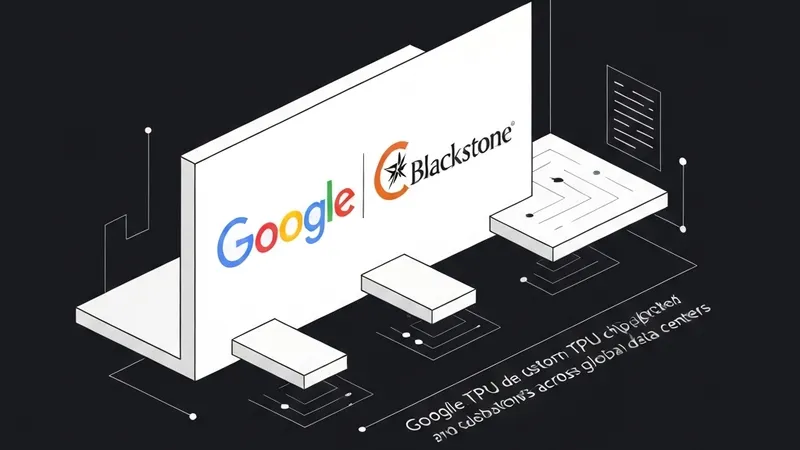
Google is significantly expanding the footprint of its proprietary Tensor Processing Unit (TPU) chips through a major new strategic partnership with Blackstone, the world's largest alternative asset manager. As generative AI models scale exponentially, the demand for power and high-density cooling in data centers has reached unprecedented levels. This partnership directly addresses the primary bottlenecks of AI infrastructure development: physical space, power grid capacity, and advanced cooling systems.
Under the agreement, Blackstone will leverage its vast data center portfolio, including QTS Realty Trust, to build and customize next-generation facilities specifically optimized for Google’s custom AI silicon, including the latest Trillium (TPU v6) chips. While Google's TPUs offer significant performance-per-watt and cost advantages, they require highly specialized direct-to-chip liquid cooling architectures and massive megawatt-scale power commitments. Blackstone’s immense capital and expertise in securing grid access will allow Google to lock down critical energy capacity ahead of competitors.
This strategic move highlights Google’s ongoing effort to diversify away from Nvidia’s GPU dominance. Although Google continues to purchase Nvidia’s Blackwell and H100 GPUs, its proprietary TPUs remain the primary engine for training and serving its signature Gemini models. By scaling TPU clusters via Blackstone’s infrastructure, Google Cloud can offer more cost-effective AI computing resources to enterprises and developers, securing a vital competitive edge against Microsoft Azure and AWS.
[AgentUpdate Depth Analysis] The partnership between Google and Blackstone transcends mere real estate and energy scaling; it represents a fundamental battle for the underlying infrastructure of the future AI Agent ecosystem. As AI Agents transition from simple conversational bots to complex, long-horizon multi-modal reasoners, the demand for low-latency, high-concurrency inference will skyrocket. The future Agent economy relies heavily on cost-efficient, ubiquitous compute. By tightly integrating custom TPUs with Blackstone’s massive capital and physical infrastructure, Google is building a vertically integrated moat spanning "power-to-silicon-to-agent." This optimized, high-volume TPU capacity will dramatically lower the marginal cost of running sophisticated multi-modal AI Agents. Ultimately, this move demonstrates that the long-term viability of advanced AI Agent platforms is inextricably linked to raw efficiency gains at the physical hardware and utility grid levels.