The consumer-grade robotics industry is undergoing a genuine generational transition. For years, quadruped robots have been capable of running, jumping, and backflipping, yet they remained practically blind and deaf when trying to comprehend the complex world. Traditional solutions relying on 2-megapixel cameras, 16-line LiDAR, and single-chip architectures left robots mechanically agile but cognitively impaired.
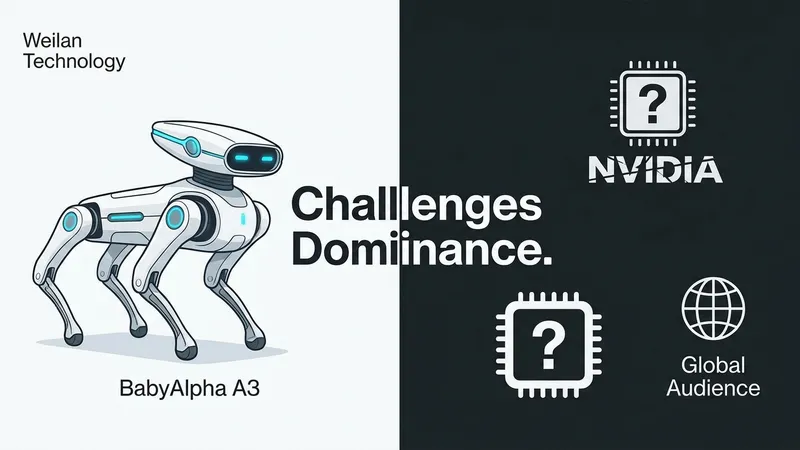
Weilan Technology's newly released BabyAlpha A3 consumer quadruped robot completely shatters this ceiling. It boasts jaw-dropping specifications: a 66-megapixel vision system, 140db HDR, a point cloud density of 2.23 million points per second, and a local edge-running speed of 280 TPS for 7B parameter models. More importantly, it bypasses Nvidia's rules entirely. By employing a self-developed 6-chip heterogeneous computing cluster, Weilan has pushed consumer robot processing efficiency to over ten times the industry standard.
In terms of perception, the A3 elevates sensory systems to a new era. It integrates a super-vision system consisting of a 50MP main camera, an f/2.8 ultra-wide camera, and a 4K panoramic camera, achieving a total resolution of 66 megapixels. Its 140db HDR dynamic range surpasses the human retina (100db-120db), ensuring crystal-clear environmental understanding even under harsh backlighting or rapid light-to-dark transitions. With a high framerate of up to 480fps, fast-moving obstacles are captured in ultra-slow motion for frame-by-frame analysis. Spatially, the A3 utilizes 5 groups of 3D ToF and 3D structured light sensors, generating a 360-degree point cloud of 2.23 million points/second—nearly two orders of magnitude higher than standard 16-line LiDAR (48k points/sec). This creates a real-time, high-fidelity 3D map. Combined with a world-first 12-Mic 3D Mesh biomimetic spatial hearing system, the A3 doesn't just hear; it pinpoints sound origin. It supports a top speed of 3.5m/s, can climb 45-degree slopes, and clears obstacles up to 28cm.
On the computational side, rather than competing on Nvidia's OrinNX single-chip path, Weilan designed an "Embodied AI Edge Hybrid Heterogeneous Computing Cluster." Built with two 5nm, two 8nm, and two 3D-stacked chips totaling a 22-core CPU, the cluster coordinates perception, decision-making, and motion control synchronously. It achieves 617 TPS on 1.5B models, 427 TPS on 3B models, and 280 TPS on 7B models. In contrast, competing edge systems running 7B models struggle to reach 6 TPS. Crucially, while Nvidia's Jetson Thor T5000 costs around $3,000, Weilan's heterogeneous solution costs approximately $300, resolving the affordability barrier for household embodied AI.
[AgentUpdate Depth Analysis] The launch of Weilan's BabyAlpha A3 represents more than a commercial hardware victory; it signals a pivotal transition for embodied AI Agents toward fully decentralized, edge-based closed loops. Historically, deploying physical AI Agents has been bottlenecked by high computing costs ("Nvidia taxes") and cloud latency. By demonstrating that a multi-chip edge cluster can outperform expensive monolithic chips in both efficiency and cost, Weilan shows a viable alternative path. This hyper-local, high-TPS intelligence allows AI Agents to perceive and act in milliseconds without cloud reliance. As the barrier to entry drops, we will see a rapid acceleration in domestic and industrial Agent ecosystems. The A3 proves that local LLMs can run with unprecedented efficiency at the edge, unlocking vast opportunities for truly intelligent, context-aware spatial Agents in everyday environments.