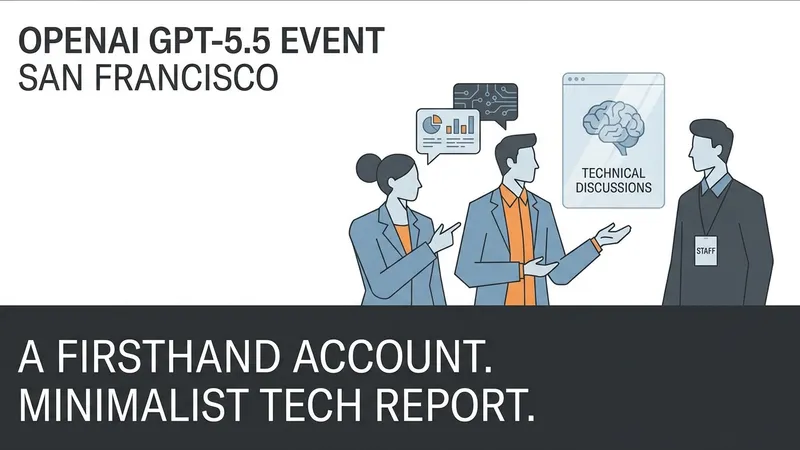
Last week, I flew from Seattle to San Francisco to attend the exclusive OpenAI GPT-5.5 Event. It was an incredible opportunity to connect with brilliant minds working across AI infrastructure, cutting-edge research, developer tooling, and emerging startups.
One of the highlights of the event was the direct access to OpenAI's Members of Technical Staff (MTS) and engineers. We dove deep into the practical technical challenges behind building and deploying large-scale AI systems. The conversations were highly pragmatic, focusing on core production bottlenecks: system reliability, inference scaling, agentic architectures, developer workflows, and rigorous evaluation frameworks for models in production.
I also thoroughly enjoyed engaging with the broader AI builder community. The side conversations were incredibly rich, covering where the modern developer tooling ecosystem is heading and how rapidly the space is evolving. It was the kind of event where you could wander into any circle and walk away with valuable, actionable insights.
As someone working in cloud reliability engineering at Microsoft with a keen interest in AI systems and infrastructure, I deeply appreciated hearing diverse perspectives from engineers building at every layer of the technology stack. Thanks to the OpenAI team for hosting such a high-caliber community event. I left San Francisco with a wealth of new ideas and a clearer view of the ecosystem's trajectory.
[AgentUpdate Depth Analysis] The anticipation surrounding GPT-5.5 signals a crucial shift from raw LLM scaling to inference-time reasoning and production-grade agentic architectures. While competitors like Anthropic focus on direct action-space manipulation (such as Computer Use), OpenAI’s technical emphasis on system-level reliability, inference-time computation, and standardized developer evaluation tools directly targets the hardest bottlenecks of deploying autonomous systems in production. This infrastructure-level focus will profoundly impact the AI Agent ecosystem. By offering a more predictable, robust, and cost-effective foundation, it lowers the integration barrier for complex multi-agent orchestration, ultimately accelerating the industry's transition from simple assistive co-pilots to highly autonomous, reliable enterprise agents.