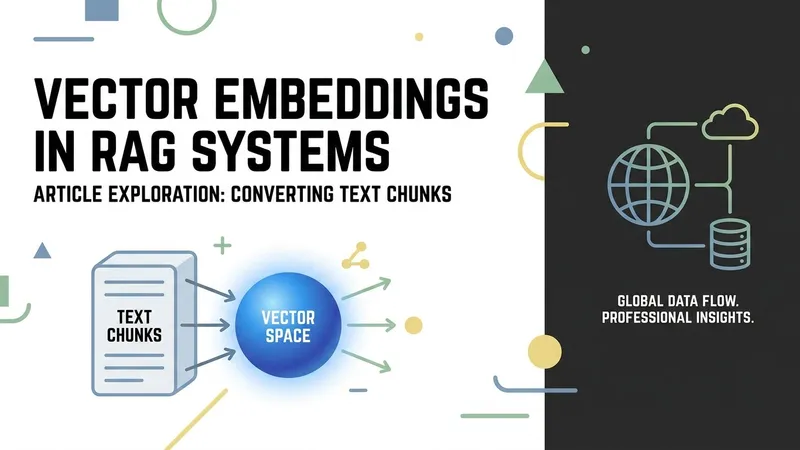
After text is split into chunks, the next critical process in RAG (Retrieval-Augmented Generation) is embedding. In this step, each chunk is converted into vectors (points in a multi-dimensional vector space) to enable highly efficient semantic search.
The primary goal of a RAG application is to achieve semantic search. For instance, the word 'feline' is semantically related to 'cat,' even though the characters are different. Semantic similarity combines user intent, context, and meaning to establish relationships between the query and stored documents. Semantically related words are stored closer together in the vector space.
To determine vector closeness, cosine similarity is the standard metric. When a query arrives, it is vectorized, and its cosine similarity with stored vectors is calculated to retrieve the closest matches. Cosine similarity works effectively because highly related vectors yield a value close to 1, while larger angles decrease the value. Alternatives like sine or tangent are rejected due to instability at small angles or wild fluctuations, making them unreliable for semantic measurement.
There are two primary retrieval methodologies:
1. KNN (K-Nearest Neighbors): Compares the query vector against all stored vectors. It offers maximum accuracy but suffers from latency on massive datasets.
2. ANN (Approximate Nearest Neighbors): Approximates the nearest vectors without comparing every point, making it ideal for massive datasets requiring ultra-fast retrieval at a slight cost to accuracy.
Additionally, embedding models generate dimensions ranging from 256 to over 3000. Higher dimensions generally capture richer, more nuanced semantic information, depending on the model's design.
[AgentUpdate Depth Analysis] Embeddings and efficient vector retrieval are no longer just RAG components; they serve as the foundational memory architecture for the evolving AI Agent ecosystem. As agents transition toward long-horizon planning and multi-modal tool-use, simple semantic search falls short. The future of Agent memory relies on understanding dynamic task contexts and behavioral intent. Consequently, hybrid retrieval methods (combining sparse and dense representations) and flexible, dimensionality-adaptive embedding techniques (like Matryoshka Embeddings) are becoming vital. Optimizing retrieval via advanced ANN indexes directly dictates an agent's reasoning capability, operational latency, and overall autonomy in executing complex, multi-step workflows.