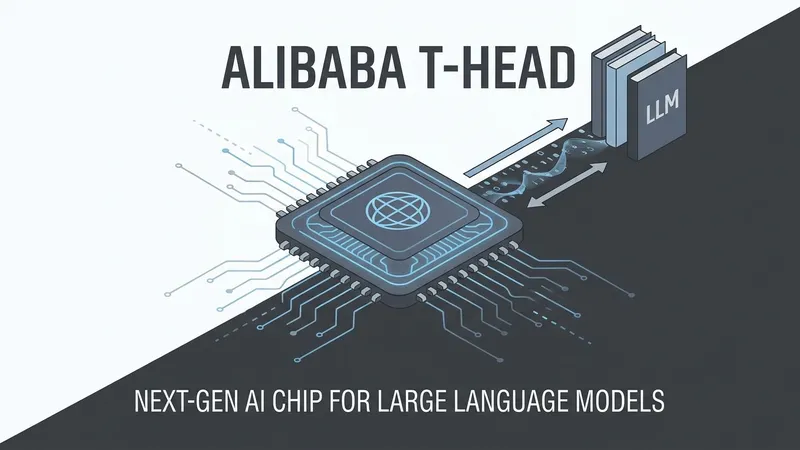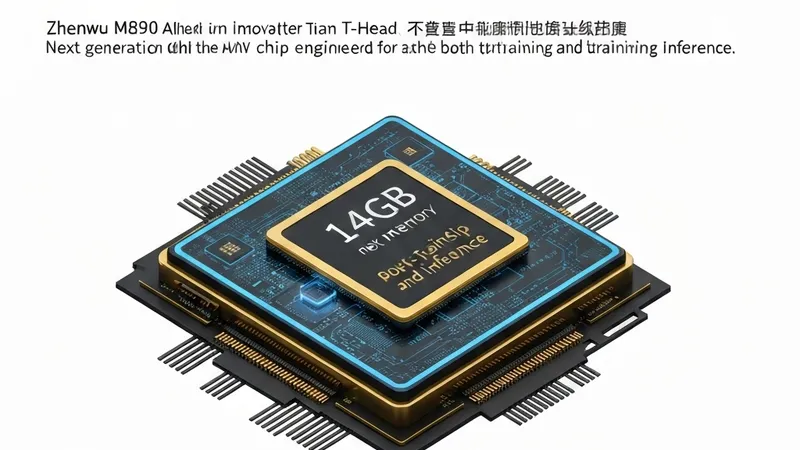
At the 2026 Alibaba Cloud Summit, T-Head semiconductor officially debuted its next-generation AI chip for both training and inference, the Zhenwu M890. Positioned as a core hardware foundation for the Agentic Era, this chip delivers breakthroughs in memory capacity, interconnect bandwidth, and multi-precision computing.
The Zhenwu M890 comes equipped with 144GB of high-bandwidth memory and achieves an impressive chip-to-chip interconnect bandwidth of 800GB/s, boasting a 3x performance increase compared to the predecessor Zhenwu 810E. It natively supports a wide range of data precisions from FP32 down to ultra-low precision FP4, making it highly versatile for high-precision training and low-precision inference across various scenarios.
To address scaling challenges in massive intelligent computing clusters, T-Head also introduced its self-developed ICN Switch 1.0 chip. When paired with Zhenwu M890, it enables full-bandwidth, lossless interconnection for up to 64 cards, significantly improving the efficiency and stability of large-scale clusters. On the same day, Alibaba Cloud launched its brand-new "Chip-Cloud-Model-Inference" full-stack technology system.
[AgentUpdate Depth Analysis] The rise of AI Agents demands a fundamental shift in infrastructure, prioritizing ultra-low latency and dynamic context-switching over sheer raw throughput. The Zhenwu M890’s native support for ultra-low precision formats like FP4 directly addresses the critical need for fast, energy-efficient Agentic inference. Furthermore, the 64-card lossless interconnection powered by the ICN Switch 1.0 optimizes collective intelligence workloads. This hardware-level synergy provides a robust foundation for multi-agent collaboration and real-time distributed orchestration. Alibaba Cloud's move demonstrates that the competitive landscape has evolved from scaling model sizes to perfecting the full-stack "Chip-to-Agent" ecosystem integration.