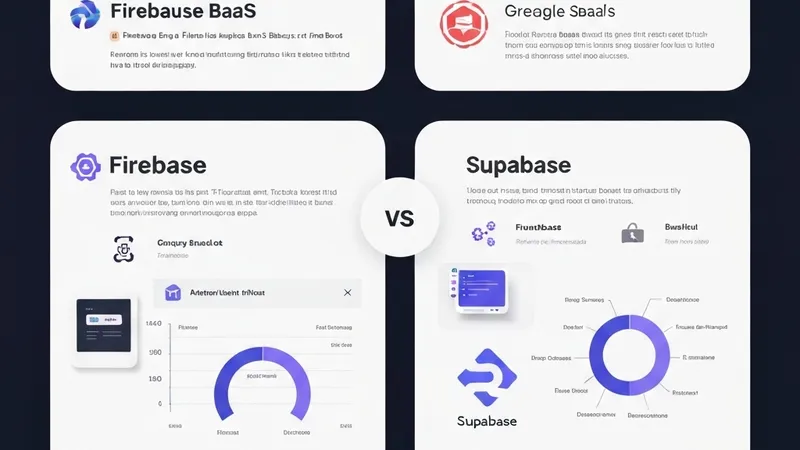
Choosing the right backend is a critical decision when building modern web or mobile applications. For years, Firebase has been the go-to choice for developers seeking rapid deployment without server management. However, Supabase has recently emerged as a powerful open-source alternative.
For developers comfortable with APIs, databases, and Create, Read, Update, Delete (CRUD) operations, this article provides a clear, neutral comparison of these two leading Backend-as-a-Service (BaaS) platforms to help you select the best fit for your next project.
Firebase at a Glance
Firebase is a comprehensive app development platform launched in 2011 and acquired by Google in 2014. It offers a suite of tools, including Cloud Firestore (a NoSQL database), authentication, serverless functions, and cloud storage.
Firebase is renowned for its real-time synchronization; data changes instantly update across all connected clients, whether web, iOS, or Android. This makes it ideal for applications like chat apps, live collaboration tools, and real-time dashboards.
Supabase at a Glance
Supabase is an open-source Firebase alternative that launched in 2020. Unlike Firebase's NoSQL approach, Supabase is built on PostgreSQL, one of the world's most advanced and trusted relational databases.
Supabase provides a real-time engine, authentication, storage, and edge functions, all while allowing developers to work with tables, rows, and Structured Query Language (SQL). It's a favorite among those who appreciate SQL but wish to avoid managing database infrastructure. Being open-source, it also offers self-hosting capabilities.
Comparing Core Features
To determine the right backend, let's examine the key components of any BaaS platform.
The Database: SQL vs NoSQL
This represents the most significant difference between the two.
- Firebase (Cloud Firestore) utilizes a document-oriented NoSQL model. Data is stored in collections of documents without a fixed schema. This provides excellent flexibility for fast iteration but can lead to complex queries and data duplication if not managed carefully. Firestore is optimized for massive scale and real-time updates.
- Supabase (PostgreSQL) employs a relational SQL database. Developers define tables, columns, and relationships (e.g., foreign keys). This structure ensures data integrity and is perfectly suited for complex data relationships—consider e-commerce orders, user profiles, and inventory. PostgreSQL is a mature, feature-rich database supporting views, functions, and triggers.
Verdict: Choose Supabase if you prefer structured relationships and SQL. Opt for Firebase if you favor JSON-like documents and need to iterate quickly without strict schema design.
Real-time Capabilities
Both platforms offer real-time functionality, though their mechanisms differ.
- Firebase: Real-time is core to its design. Any client listening to a document or collection receives updates instantly.