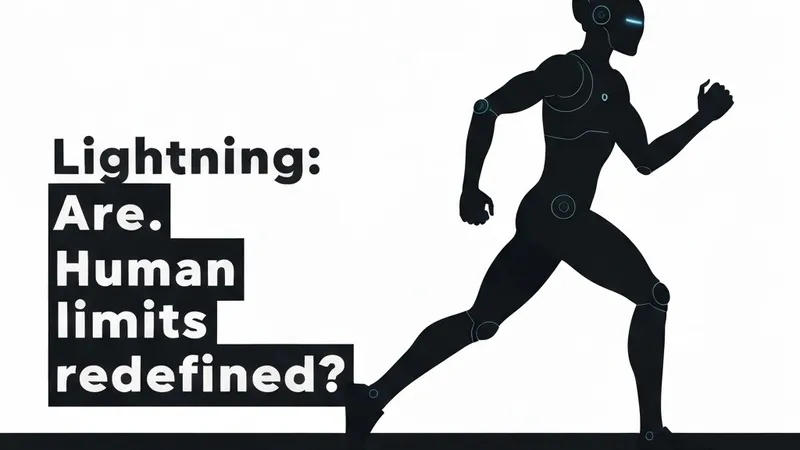
Last month, at the Beijing half marathon, a robot named Lightning achieved an extraordinary feat, beating the human world record by nearly seven minutes. This milestone has reignited discussions on whether robots are on the verge of their "ChatGPT moment" – poised to seamlessly integrate into our daily lives, much like how chatbots have revolutionized digital interactions.
China is at the forefront of this technological push, with its government pledging an ambitious investment of over £100 billion (approximately $127 billion USD) in robotics over the next two decades. This significant commitment underscores the nation's strategic focus on leading the global advancements in AI and robotics.
Robots are already making significant inroads into the workforce, performing tasks that enhance efficiency and safety in various industries. However, the transition of robots from industrial settings to everyday domestic roles, such as cleaning our homes or weeding our gardens, presents a unique set of challenges. These include developing more sophisticated sensory perception, advanced decision-making capabilities, and crucially, human-like dexterity.
Ian Sample, host of the podcast, delves into these complexities with Amy Hawkins, the Guardian’s senior China correspondent, and Nathan Lepora, Professor of Robotics and AI at Bristol University. Professor Lepora's research specifically focuses on enabling robots to achieve human-like dexterity, which he identifies as a critical enabler for their widespread adoption in personal and household applications. The experts highlight that while massive investments like China's will accelerate R&D, overcoming these dexterity and human-robot interaction hurdles will be key to unlocking the full potential of robots in our homes.
[AgentUpdate Depth Analysis]The "Lightning" robot's marathon record is more than a display of athletic prowess; it's a powerful indicator of AI Agents' burgeoning capabilities in real-world physical interaction. Unlike traditional industrial robots confined to repetitive, fixed tasks, this performance hints at AI Agents — endowed with autonomous decision-making and environmental adaptability — transcending digital confines into the physical realm. Compared to Boston Dynamics' Atlas, which prioritizes complex dynamic balancing, "Lightning" excels in sustained, efficient biomimetic movement. Humanoid robots like Figure 01, conversely, emphasize multimodal perception and intricate task execution. The future of the AI Agent ecosystem will increasingly involve embodied AI, where agentic logic is deployed onto physical robots. This progression signifies that agents will directly impact and modify the physical world, facilitating tasks from logistics and home services to exploration. The profound implication is a massive expansion of AI Agent applications, upgrading them from virtual assistants to "intelligent laborers" with physical agency, thereby blurring the lines between the digital and physical and fostering entirely new industries and business models. These highly autonomous, physically interactive AI Agents are set to become indispensable infrastructure for a truly intelligent society, fundamentally reshaping our production and daily lives.