Anthropic has officially launched Claude Opus 4.8, accompanied by two major updates to Claude Code. The highlight of this release is "Dynamic Workflows," a feature that runs multiple subagents in parallel at scale. Additionally, Fast Mode now supports Opus 4.8 at a lower price point. Both features are currently available as research previews.
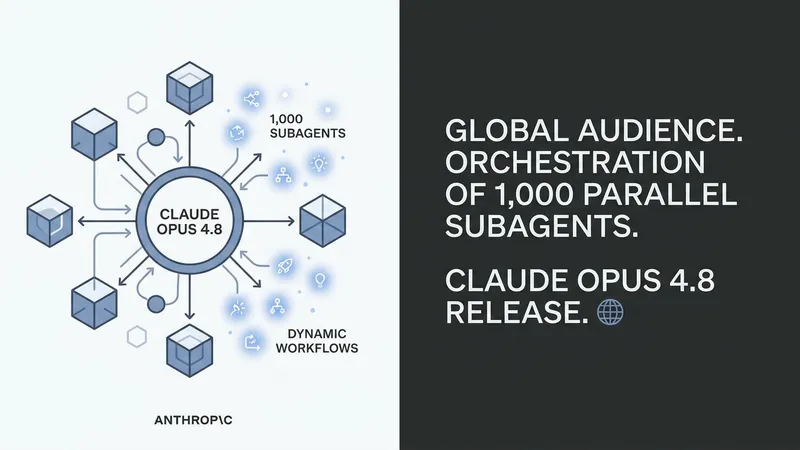
A dynamic workflow is essentially a JavaScript script that orchestrates subagents at scale. Claude automatically writes the script based on your task description, which a runtime then executes in the background. Your main session remains fully responsive while the agents are at work. Crucially, the execution plan is translated into code rather than cluttering Claude’s context window. Intermediate results are stored in script variables, ensuring that Claude's context only holds the final answer—a key architectural departure from traditional subagents and skills.
This feature requires Claude Code v2.1.154 or later, running via the CLI, Desktop, or VS Code extension. It is available on Max, Team, and Enterprise plans (enabled by default on Max and Team, requiring admin activation on Enterprise). It also supports the Claude API, Amazon Bedrock, Vertex AI, and Microsoft Foundry.
Workflows can be triggered in two ways: by including the word "workflow" anywhere in your prompt, or by enabling the "ultracode" setting, which pairs maximum reasoning effort with automatic workflow orchestration. Claude Code also includes "/deep-research" as a built-in workflow.
During a run, Claude plans dynamically, breaking tasks into subtasks and fanning them out to up to 16 concurrent agents (capped at 1,000 agents per run). Agents address the problem from independent angles, while other agents attempt to refute their findings, iterating until answers converge. The workflow script itself cannot access the filesystem or shell; only the individual agents have read/write and execution permissions.
Progress is saved incrementally, allowing interrupted jobs to resume with cached results. A prominent real-world example is Jarred Sumner’s migration of Bun from Zig to Rust using dynamic workflows. The migration achieved a 99.8% pass rate on the existing test suite, producing roughly 750,000 lines of Rust code in just 11 days. Lastly, Fast Mode is a high-speed configuration of Claude Opus that delivers 2.5x faster output speeds at a lower cost without sacrificing intelligence, togglable via the "/fast" command.
[AgentUpdate Depth Analysis] Anthropic’s Dynamic Workflows represent a major paradigm shift in multi-agent orchestration, directly addressing the scaling bottlenecks of existing frameworks like AutoGen or LangGraph. Traditional multi-agent systems suffer from extreme context bloat and state accumulation within the prompt history. By compiling execution logic into a standard JavaScript runtime, Anthropic elegantly decouples reasoning from state execution. Managing intermediate data in code variables rather than LLM memory allows scaling up to 1,000 parallel subagents without any context degradation. This evolution from fragile prompt-chaining to structured, compiler-driven execution effectively turns AI into a deterministic, self-correcting software factory. It lays down the critical infrastructure for highly resilient, autonomous enterprise-grade engineering systems.