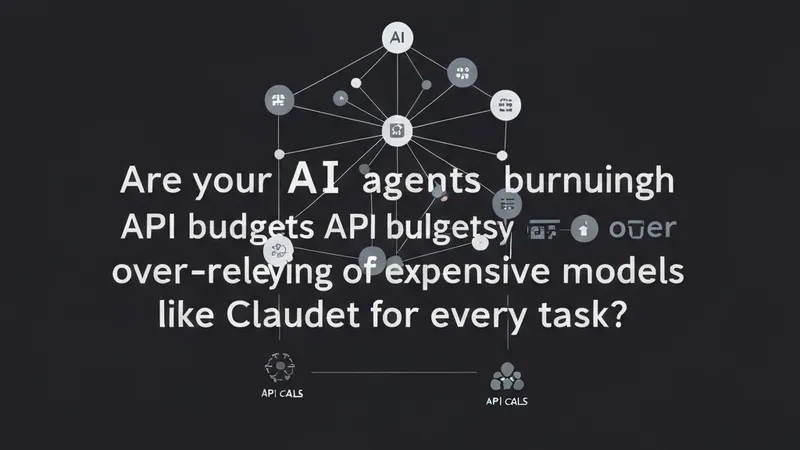
In the realm of AI agents, a prevalent issue for developers is the escalating API costs. This often stems from agents indiscriminately defaulting to expensive frontier models like Claude Sonnet for every task, irrespective of complexity—from simple classification to multi-step analysis. This 'one-size-fits-all' approach is not only costly but also largely unnecessary, as many agent operations do not demand the highest-tier reasoning capabilities.
To address this challenge, a production-proven 4-tier model routing architecture has been developed. This system significantly cuts API expenses, often to near-zero for a large class of tasks, while maintaining the required quality for critical operations, making it ideal for autonomous, long-running agents.
The Core Problem: One Model For Everything
Autonomous agents execute numerous tasks that are not always directly observed by developers, such as inbox polling, content classification, summarization, routing decisions, content extraction, and cache lookups. Critically, most of these tasks do not necessitate the power of a Claude Sonnet. However, if an agent calls the Anthropic API for all these operations, you're paying Sonnet prices for work that a local 7B parameter model can handle correctly 95% of the time.
Over a day of continuous autonomous operation—including frequent inbox checks, background monitoring, and content generation—these costs compound rapidly. Furthermore, this approach consumes valuable rate limits and subscription headroom that should be reserved for tasks genuinely warranting frontier-level quality and reasoning.
The Solution: A 4-Tier Model Routing Architecture
The fix lies in implementing a tiered routing system where each task is assigned to the cheapest tier capable of handling it correctly. The architecture comprises the following tiers:
- Tier 0 | Local (Ollama): Handles basic tasks such as classification, routing, summarization, and extraction.
- Tier 1 | Claude Haiku: Dedicated to structured tasks that require API-quality output.
- Tier 2 | Claude Sonnet: Reserved for primary reasoning, code generation, and complex multi-step synthesis.
- Tier 3 | Claude Opus: Used exclusively for the highest-stakes decisions and irreversible actions, with minimal usage.
The strategic objective is to push as much workload as possible to Tier 0 for zero cost, utilize Tier 1 for reliable structured outputs, allocate Tier 2 for actual deep reasoning, and treat Tier 3 as a rarely accessed, ultimate decision-making layer.
Tier 0: Local Inference With Ollama
Ollama facilitates running language models locally. On systems equipped with a capable GPU or NPU, local inference is remarkably fast. Even on CPU-only machines, it remains viable for asynchronous tasks.
To set up and utilize local models:
First, install Ollama via its installation script:
curl -fsSL https://ollama.com/install.sh | shNext, pull a suitable local model, for instance:
ollama pull qwen2.5:7b # 4.7GB — a good generalist model, fastFor potentially better quality, a larger model can be chosen:
ollama pull qwen2.5:14b # 9GB — offers improved quality but is slowerVerify the installed models and test a simple classification task:
ollama list
ollama run qwen2.5:7b "Classify this task: summarize a user inbox message. Return: classification/routing/generation/analysis"
To ensure Ollama runs automatically upon system boot, it can be configured as a cron job.