OpenAI Co-founder and President Greg Brockman recently unveiled the company's significant strategic shift: a concentrated focus on developing a "Super App" that integrates programming, a browser, and ChatGPT, alongside teasing a new pre-trained model internally codenamed "Spud."
Brockman clarified that Sora has not been abandoned but strategically re-prioritized. He explained that OpenAI had been pursuing dual tracks of deep learning research and technology deployment. Now, with technology proven feasible, the company must shift its focus to real-world application feedback to advance further. He emphasized this is not a pivot from consumer to B2B but a drive to concentrate on synergistic, impactful applications that benefit everyone.
Regarding the technological roadmap, Brockman noted that the Sora video model and the GPT series (core reasoning models) represent different branches of the tech tree. Sora research will continue within the robotics domain, but as robotics technology is still in the research phase, it's not yet mature for large-scale deployment in knowledge work. Therefore, OpenAI's current strategy is to prioritize the GPT series, encompassing text and voice interactions, which can be fine-tuned on the same underlying model. With limited compute resources, simultaneously advancing two vastly different product branches is extremely challenging.
OpenAI firmly believes that text models can lead to AGI, asserting that AGI is "right around the corner" with even stronger models expected this year. Brockman cited an example where an OpenAI model solved a long-standing physics problem in 12 hours, underscoring the importance of such "thinking" capabilities. He stated that OpenAI's mission is to bring AGI to the world, necessitating a focus on a core technological path and pushing it to its limits, unifying the tech stack to support the entire economy.
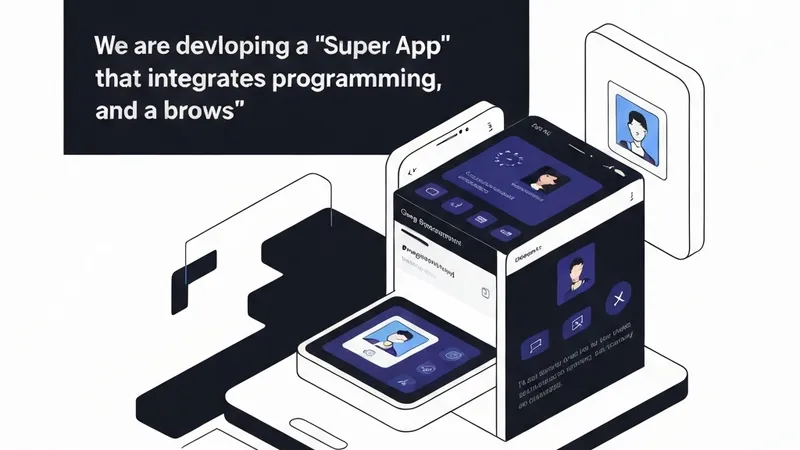
Describing the "Super App," Brockman revealed it will integrate programming, a browser, and ChatGPT, aiming to build an endpoint application where users can experience the power of AGI. It will function not just as a tool but as a "personal assistant" that understands, aligns with user goals, and is trustworthy. He envisions a future where computers adapt to humans, rather than the inverse. This app will feature memory, connecting to users' emails and calendars to help achieve goals at a deeper level. The rollout will be phased over the coming months, beginning with the Codex application, which serves as a general intelligent agent framework adept at software development, later expanding to more knowledge work scenarios.
Addressing the competitive landscape with rivals like Anthropic, Brockman acknowledged that while OpenAI has always prioritized programming, it previously lacked "last-mile" usability. By mid-last year, a dedicated team was formed to tackle real-world codebase challenges, building training environments to enhance AI's ability to handle the interruptions and complexities of actual software engineering. He believes the current competitive environment is healthy, keeping the OpenAI team humble and unified, focused on core objectives rather than "side quests."
Regarding the rumored new model, "Spud," Brockman emphasized that its core significance isn't merely in its name as "a specific model," but rather as a re-pre-trained model embodying OpenAI's efforts over the past two years. It is not merely another iteration in the "GPTxxx" series, but is designed to be smarter and more "compliant," capable of solving more complex problems, with enhanced understanding and contextual grasp.