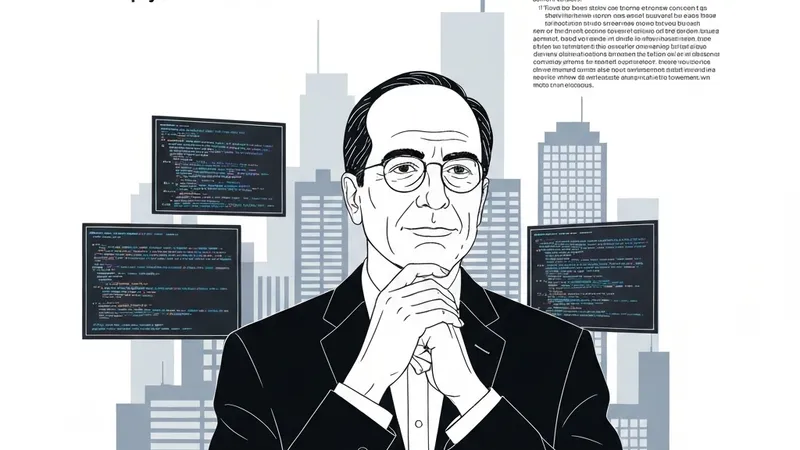
Daron Acemoglu, awarded the Nobel Prize in economics in 2024, published a paper months before his win that challenged prevailing Silicon Valley narratives. Contrary to promises from Big Tech CEOs about AI revolutionizing all white-collar work, Acemoglu estimated that AI would provide only a modest boost to US productivity and wouldn't negate the need for human labor. He argued that AI excels at automating specific tasks, but many jobs would remain largely unaffected.
Two years later, Acemoglu's nuanced perspective hasn't fully permeated public discourse; discussions about an AI-driven jobs apocalypse are widespread. While data still supports Acemoglu's initial stance—studies consistently show AI not significantly impacting employment rates or layoffs—the technology has advanced considerably. This article explores whether recent AI developments have altered his thesis and what concerns him currently, beyond the immediate prospect of AGI.
The Rise of AI Agents and Acemoglu's Critique
A significant technical leap in AI since Acemoglu's paper has been the emergence of agentic AI. These tools go beyond chatbots, capable of operating autonomously to achieve specified goals. Their ability to work independently, rather than merely answering queries, has led companies to increasingly position agents as a scalable replacement for human workers.
However, Acemoglu views this as "a losing proposition." He suggests that agents are better conceptualized as tools designed to augment particular segments of a person's work, rather than being adaptable enough to manage an entire job.
One key reason for this perspective stems from the multifaceted nature of human jobs, a topic Acemoglu has researched extensively since 2018. For instance, an x-ray technician manages approximately 30 distinct tasks, from compiling patient histories to organizing mammogram image archives. Humans naturally fluidly switch between various formats, databases, and working styles to accomplish this. Acemoglu questions how many individual AI tools or protocols would be required for an AI to replicate this seamless transition.
The ultimate impact of AI agents on employment will hinge on their capacity to manage the intricate "orchestration" between tasks—a skill humans perform instinctively. While AI companies are intensely competing to demonstrate agents' prolonged independent operation without errors, sometimes with exaggerated claims, Acemoglu asserts that numerous jobs will be safe from AI takeover if agents cannot fluidly transition between diverse tasks.