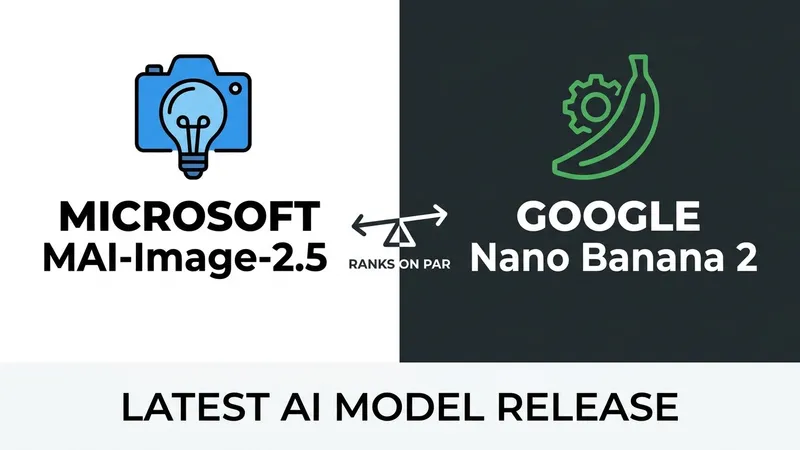
Microsoft has rolled out an update to its MAI image model, introducing MAI-Image-2.5. According to the MAI team, this model now ranks third on Arena's text-to-image leaderboard, placing it on par with Google's Nano Banana 2, though it remains a clear step behind OpenAI's Image-2.
Microsoft touts MAI-Image-2.5 as its strongest MAI image model to date, showcasing significant improvements over MAI-Image-2 in text rendering, stylized illustrations, and commercial visuals. The company also states that the model follows prompts more closely and generates more consistent lighting, depth, and spatial relationships. Microsoft is actively positioning it for professional use cases such as product photography and brand design.
Based on Arena's ranking, MAI-Image-2.5 distinctly outperforms its predecessors across all eight categories, with particularly strong showings in text rendering, portraits, and commercial motifs.
MAI-Image-2.5 is currently available on Arena and is expected to be integrated into the MAI Playground and Foundry platforms within the next two weeks.
[AgentUpdate Depth Analysis] The launch of Microsoft's MAI-Image-2.5, matching Google's Nano Banana 2 in text-to-image benchmarks, signals a critical advancement for the AI Agent ecosystem, particularly in visual interaction and content creation. While models like Stable Diffusion, Midjourney, and DALL-E 3 already push boundaries, MAI-Image-2.5's strong performance intensifies competition and raises technical expectations. For AI Agents, this translates into an enhanced ability to move beyond mere text generation to accurately and creatively visualize concepts. Future agents can act as "visual directors" or "creative professionals," generating bespoke ad campaigns, illustrating reports automatically, or dynamically constructing virtual environments in real-time. This capability will significantly broaden the application scope of AI Agents into visually-dependent sectors such as architectural design, fashion trend forecasting, and game content production. It simultaneously demands more sophisticated decision-making from agents—how to intelligently select and combine these powerful visual generation tools based on complex user intent and context. We can anticipate a future where deeply integrated image generation models power a new era of visually driven, autonomous, and highly intelligent AI Agents.