Mathematical reasoning serves as a cornerstone for problem-solving in education, science, and industry, standing as a vital benchmark for assessing artificial intelligence. As Large Language Models (LLMs) continue to advance, a profound understanding of their mathematical reasoning capabilities has never been more critical. A newly released survey paper, "Mathematical Reasoning in Large Language Models: Benchmarks, Architectures, Evaluation, and Open Challenges" (arXiv:2605.19723), provides a timely and systematic synthesis of this domain.
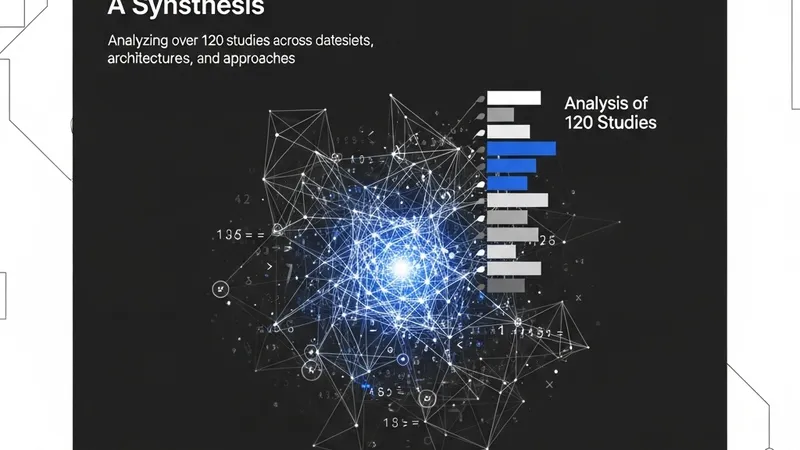
Reviewing approximately 120 peer-reviewed papers and preprints, this survey establishes a unified taxonomy of mathematical datasets, distinguishing among pretraining corpora, supervised fine-tuning (SFT) resources, and evaluation benchmarks across various complexity levels. This structure helps researchers pinpoint data requirements and evaluation metrics for each stage of LLM development.
The study deeply analyzes reasoning architectures and training strategies, showcasing the integration of external tools, verifier-guided reasoning, and parameter-efficient fine-tuning (PEFT) to boost robustness and generalization. Crucially, the authors highlight the critical gap between simple final-answer accuracy and process-level reasoning verification, advocating for more granular metrics.
Finally, the paper identifies persistent failure modes, such as reasoning faithfulness issues, benchmark biases, and generalization constraints. It outlines essential research directions, focusing on enhancing symbolic grounding and evaluation reliability to forge more trustworthy reasoning systems.
[AgentUpdate Depth Analysis] Mathematical reasoning is far more than an academic benchmark; it serves as the cognitive foundation for complex planning and tool orchestration in autonomous AI Agents. While standard LLMs often fail at multi-step tasks due to error propagation, integrating process-level verification and symbolic grounding enables agents to transition from reactive generation to deliberate, "System 2" reasoning. This shift is crucial for mitigating hallucinations during agentic workflows. Compared to heuristic-based agents, verifier-guided reasoning architectures allow agents to self-correct in dynamic environments. Ultimately, solving the mathematical reasoning bottleneck will unlock highly reliable, task-oriented agents capable of executing sophisticated scientific, financial, and software engineering workflows with rigorous trust boundaries.