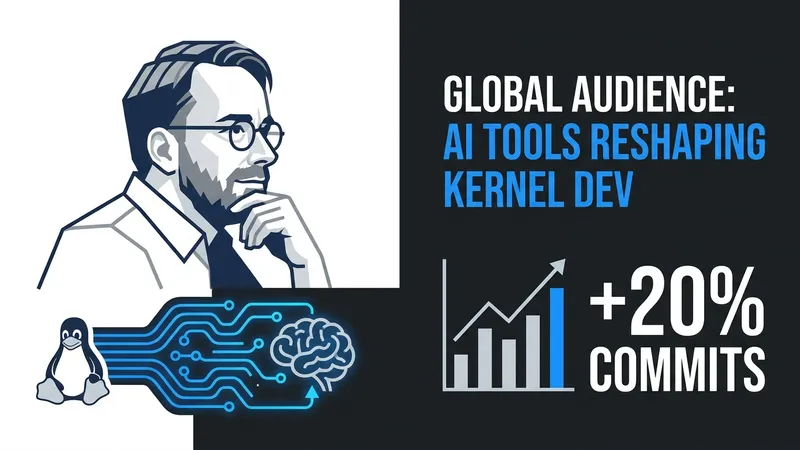
At the Open Source Summit North America, Linux creator Linus Torvalds addressed the role of AI in the industry, suggesting that while AI tools are reshaping kernel development, they remain a sophisticated tool rather than a replacement for human expertise. Torvalds noted a 20% increase in commits for recent kernel versions. Initially attributing this surge to excitement over the jump to version 7.x, he later realized it was the direct result of significant advancements in AI-assisted programming tools over the past six months.
Torvalds acknowledged that AI lowers the barrier for entry for new contributors, but pointed out that its most significant impact is social rather than technical. A prime example is the influx of repetitive bug reports flooding security mailing lists. To combat this, the kernel team has established new guidelines. He also took the opportunity to urge security researchers to avoid premature vulnerability disclosures. Recently, four privilege escalation bugs were made public before maintainers were even notified, a move Torvalds criticized as being driven by a desire for attention.
Regarding security, Torvalds argued that closed-source models are actually worse because they prevent AI from being utilized effectively to help users fix bugs. He emphasized that maintenance is a human-centric endeavor. As a lead maintainer, his primary role involves collaboration with people, not just managing code. He expressed a firm stance against using AI for human-to-human interactions and advised other developers to follow suit.
Torvalds contextualized AI within his own career, viewing it as the latest step in a long line of productivity enhancements: from manual machine code entry to assemblers, compilers, and now AI assistants. While AI changes how code is written, it does not change the core nature of programming. Developers must still understand the generated output and its final results to maintain complex systems long-term. He concluded that software is inherently complex, and open source remains the only effective way to manage that complexity, with AI serving as just another powerful instrument in the developer's toolbox.