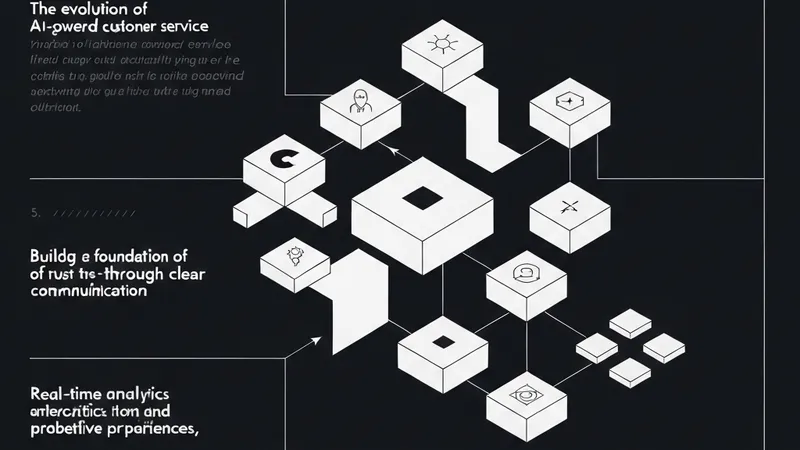
Building an AI chatbot for customer service presents a multifaceted challenge, particularly when aiming for high accuracy and user satisfaction. Leveraging Large Language Models (LLMs) requires careful architectural design to overcome inherent limitations and maximize their potential.
One of the primary hurdles is establishing an effective knowledge base. Simply feeding LLMs with raw documentation like PDFs can lead to hallucinations or a failure to grasp specific contexts. The most effective solution involves converting extensive documentation into manageable chunks, storing them in a vector database (e.g., Pinecone), and employing Retrieval-Augmented Generation (RAG). This approach ensures that the LLM retrieves relevant information before generating a response. Crucially, rich metadata associated with these chunks allows for precise filtering and improved retrieval accuracy.
Overcoming ambiguity and maintaining context across conversations is another significant challenge. Users often ask vague questions, and without proper context, LLMs can struggle to understand intent. Implementing multi-turn dialogue management and utilizing conversational history are vital. Advanced strategies include using an LLM itself to rephrase or clarify user queries, helping to refine the input and guide the conversation more effectively.
Personalization is key to a superior user experience, moving beyond generic responses. Integrating the chatbot with Customer Relationship Management (CRM) systems allows access to user-specific data, such as names or order histories. This enables the chatbot to provide tailored, contextually relevant answers, significantly enhancing user engagement. However, this also necessitates strict adherence to data privacy regulations and ethical considerations.
Scalability and performance are critical for enterprise-level deployment. LLM inference can be computationally intensive and costly. Solutions include implementing caching mechanisms for frequently asked questions, strategically selecting smaller, more efficient LLMs for simpler tasks, and employing asynchronous processing. Utilizing cloud-based AI services can also help manage the infrastructure demands and ensure high availability.
Finally, continuous improvement is indispensable. Chatbots are not static; they require ongoing refinement based on real-world interactions. Establishing a human feedback loop, conducting A/B testing on different response strategies, and regularly monitoring conversations are crucial. This feedback allows for data-driven fine-tuning and iterative development, ensuring the chatbot evolves to meet user needs more effectively over time.