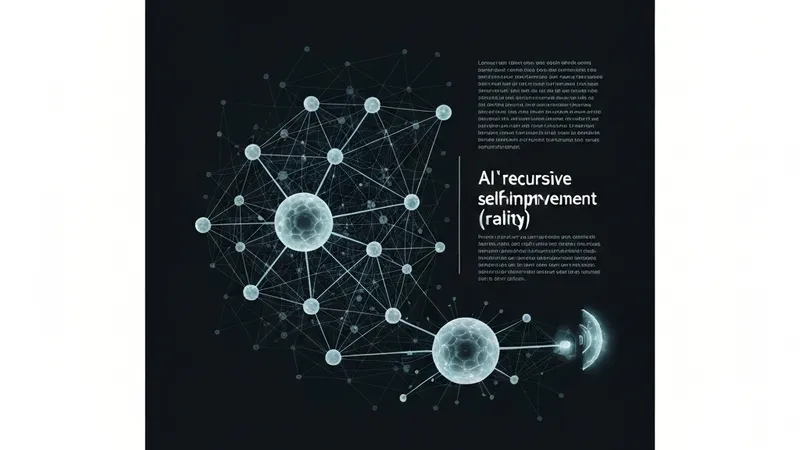
The vision of machines improving themselves, first theorized by I. J. Good in 1966 as leading to an "intelligence explosion," has long positioned recursive self-improvement (RSI) as both a scientific aspiration and a cautionary tale within AI research. Today, advancements are prompting critical questions about the extent to which parts of this self-improvement process are already manifesting.
RSI is interpreted across a spectrum. While some employ the term for regulatory fear-mongering or marketing hype, and definitions range from fully autonomous loops to any technological assistance in tech development, a stricter interpretation focuses on systems that enhance not just their outputs, but the underlying methods of improvement—generating ideas, evaluating outcomes, and modifying their processes without human direction. By this rigorous standard, many current systems fall short. They can significantly aid in developing better AI, yet human involvement remains crucial for setting objectives, defining success metrics, and validating changes. The key inquiry is not if self-improvement exists, but how much of this intricate feedback loop has genuinely been closed.
Decades of research have progressively established the foundational elements of RSI. Machine learning (ML) algorithms now automatically fine-tune program parameters, enabling machines to excel at games or even create new programs. Evolutionary algorithms, another ML method, diversify and iterate on design solutions, including other algorithms. Furthermore, "AutoML" has streamlined aspects of the ML pipeline, automating the structuring, training, and evaluation of models like neural networks over the past decade.
This trajectory is significantly extended by contemporary large language models (LLMs) such as GPT, Gemini, Claude, and Grok. A primary application for these LLMs is code generation, encompassing the creation of code for their own future versions. OpenAI reported in February that GPT-5.3-Codex played a critical role in its own development, assisting with debugging training, managing deployment, and analyzing evaluation results. Similarly, Anthropic states that Claude Code now writes the majority of its own underlying codebase. However, these systems still necessitate human direction and verification to guide their work effectively.
Last year, Google DeepMind unveiled AlphaEvolve, a "coding agent for scientific and algorithmic discovery." This system employs LLMs to guide the evolution of solutions for complex tasks, including optimizing neural-network architectures, scheduling data-center operations, and designing advanced chips. While AlphaEvolve represents a significant leap, it does not constitute a fully recursive loop, as human input is still required to define problems and assess performance. Nevertheless, each breakthrough it enables amplifies scientists' capacity to achieve further AI advancements, fostering what Matej Balog of Google DeepMind describes as a "very collaborative process" between humans and machines.