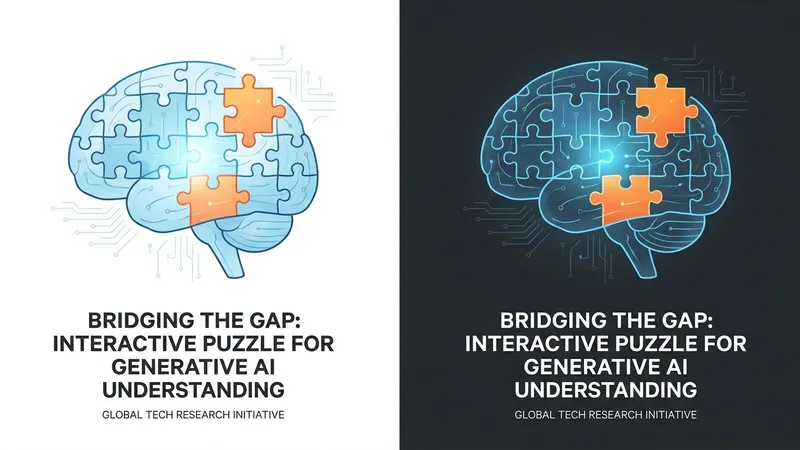
The rapid adoption of Generative AI, spearheaded by LLM-based chatbots like ChatGPT, has underscored an urgent need for accessible methodologies to support public understanding and AI literacy. To address this education gap, a newly published paper (arXiv:2605.20404) introduces an innovative, game-based, interactive approach in the form of a physical jigsaw puzzle.
Once fully assembled, the puzzle reveals a comic-based infographic illustrating the underlying mechanisms, capabilities, limitations, and societal implications of these large language models. Rather than relying on dense text, each comic sketch also doubles as a standalone informational card. These cards provide focused, modular explanations of specific facets of AI design, deployment risks, and ethics.
The visual content was synthesized during a live collaborative session featuring a professional illustrator alongside a multidisciplinary group of domain experts and non-experts. This co-design process successfully merged structured technical knowledge with informal, exploratory reflections. By combining tactile, hands-on assembly, visual storytelling, and collaborative game play, the puzzle serves as an engaging and playful tool for demystifying the perks and perils of modern AI systems in informal learning environments.
[AgentUpdate Depth Analysis] As AI Agents transition from static assistants to autonomous, multi-agent workflows, 'explainability' and 'user trust' have emerged as critical bottlenecks for widespread adoption. This research highlights an ingenious paradigm shift: utilizing physical metaphors and gamified visualization to demystify complex neural architectures. For the broader AI Agent ecosystem, this approach offers profound design principles. Future agent frameworks should move away from opaque 'black-box' operations and toward modular, 'jigsaw-like' visual interfaces. By decomposing an Agent's reasoning, tool-calling, and planning steps into digestible, interactive modules, developers can foster cognitive alignment between humans and autonomous systems. Enhancing AI literacy through tangible interaction is not just an educational gimmick; it is a foundational step toward building high-trust, collaborative human-agent environments.