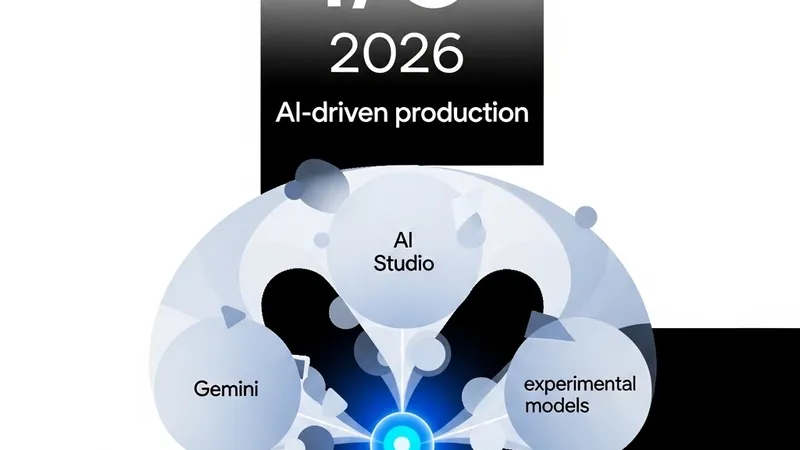
Google I/O 2026 served as a testament to AI's utility, not just as a product on stage, but as an essential force behind the production scenes. By utilizing the same Gemini-powered tools they championed, the Google team fundamentally rewrote the rules of event creation and high-stakes content production.
The centerpiece of this integration was the short film "TPU Training Day." The project aimed to elevate low-fidelity materials—cardboard and markers—into a professional animated film. The tech stack included Google AI Studio, experimental DeepMind models, Gemini Omni, and the Nano Banana model. The process required a human-in-the-loop strategy: director Laurie Rowan and Nexus Studios handled initial puppetry and 3D movement to retain human artistic intent, while Nano Banana was deployed to generate stylized frames.
To solve the challenge of frame consistency, the team developed custom tools within Google AI Studio, enabling them to test and scale frame generation across the production. This paradigm allowed the team to offload mundane animation tasks to AI, permitting human creators to focus on narrative and emotional beats, effectively demonstrating a scalable model for modern digital artistry.
[AgentUpdate Depth Analysis] The production of I/O 2026 signals a critical evolution in the AI Agent ecosystem: the transition from interactive assistants to autonomous creative orchestrators. By embedding Gemini and specialized models into a multi-stage production pipeline, Google has demonstrated how AI Agents can act as the glue between fragmented creative workflows. The innovation here lies in the use of custom toolsets within AI Studio to ensure visual consistency, an area that has historically plagued generative models. For the future of the Agent ecosystem, this approach points toward "Agentic Workflows" where agents manage constraints and optimize outputs in real-time based on high-level artistic directives. This shifts the role of the creator from a manual technician to an architectural supervisor. As these agents gain the ability to chain specialized models for complex tasks, we are witnessing the birth of a new generative economy where the barrier between imagination and high-fidelity production is effectively dismantled by intelligent, context-aware agents.