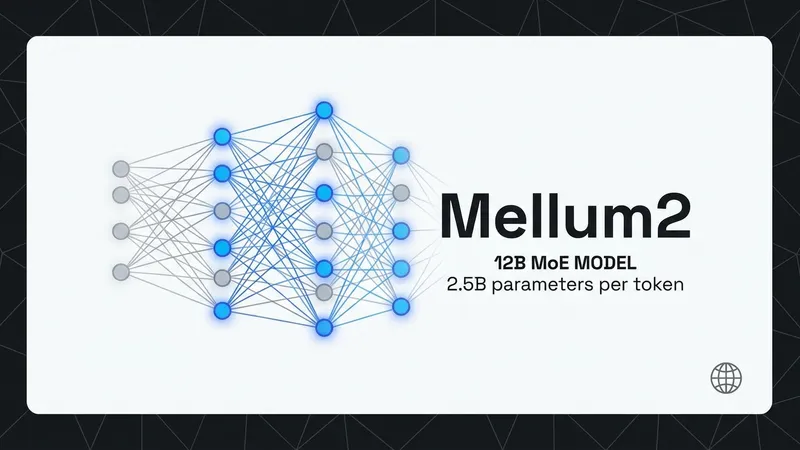
JetBrains has announced the release of Mellum2, a 12B parameter Mixture-of-Experts (MoE) model trained from scratch, specifically optimized for natural language and code generation. By activating only 2.5B parameters per token, the model achieves high-throughput and low-latency inference, bridging the gap between performance and operational efficiency.
Evolving from JetBrains' legacy in code completion, Mellum2 now addresses a wider array of software engineering and general-purpose tasks. In modern AI architectures—which increasingly rely on complex multi-step workflows like RAG, model routing, and automated planning—latency is a critical bottleneck. Mellum2 is engineered to resolve this by providing a lightweight, efficient engine for these operations, avoiding the over-utilization of massive LLMs.
The MoE architecture ensures that the model retains significant parameter capacity while maintaining a lean execution footprint. Benchmarks indicate that Mellum2 is highly competitive with similarly sized models while delivering more than 2x faster inference speeds. Its use cases include acting as a controller for model routing and orchestration, optimizing RAG pipelines via context compression, serving as a sub-agent for complex planning, and enabling secure, private deployments for high-throughput production environments.
[AgentUpdate Depth Analysis] The launch of Mellum2 underscores a critical transition in the AI Agent landscape: the shift toward specialized, task-specific inferencing. As Agent frameworks evolve into sophisticated multi-agent ecosystems, the industry is recognizing that utilizing massive frontier models for every sub-step—such as tool selection, input validation, or prompt routing—is unsustainable both in terms of latency and capital expenditure. Mellum2's 12B MoE design, with its sparse 2.5B active parameter count, hits a 'sweet spot' for production-grade Agent orchestration. Compared to general-purpose dense models or larger MoE variants like Mixtral, Mellum2 offers a surgical precision for software-centric workloads, making it a powerful contender for the 'orchestrator' tier in Agent architectures. For developers building autonomous systems, Mellum2 represents a strategic move toward modularity—decoupling complex reasoning tasks from low-latency, high-frequency execution tasks—a necessity for achieving true human-level response times in real-time developer tooling and enterprise automation platforms.