At the latest Google I/O, Google demonstrated a sweeping AI-first transformation across its entire product lineup. With the Gemini App surpassing 900 million monthly active users and handling over 3,200 trillion tokens per month, Gemini is transitioning from a standalone application into the fundamental AI engine powering Google's search, Chrome, developer tools, and XR ecosystems.
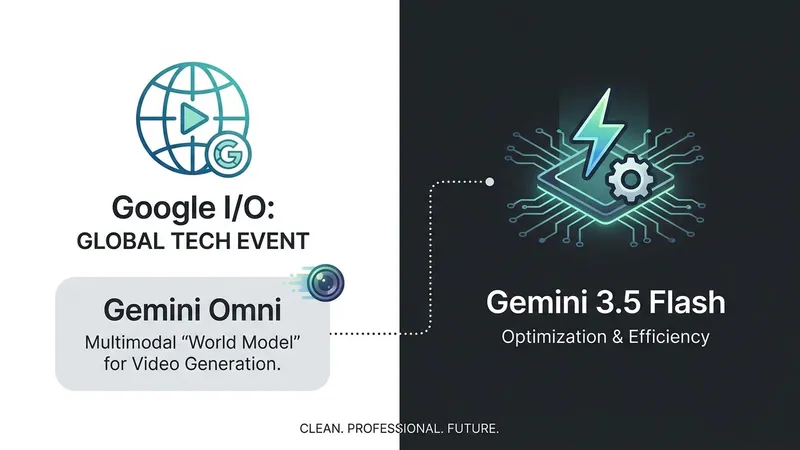
The keynote's main highlights centered on multimodality and the agentic ecosystem. Google first introduced Gemini Omni, described by DeepMind as a step toward "world models." Gemini Omni merges reasoning with generative media models to understand physics concepts like kinetic energy and gravity. During the demo, a simple prompt generated a clay-animation video explaining protein folding, and users could naturally edit videos via dialogue—such as turning a standard shape into a black hole. Gemini Omni Flash is now live, with Omni Pro coming soon.
For developers, Google launched Gemini 3.5 Flash, a model engineered for speed, cost efficiency, and long-horizon tasks, particularly agentic coding. It boasts output token speeds up to 4x faster than other frontier models (and up to 12x under specific Antigravity optimizations), showing marked improvements in coding benchmarks and real-world task evaluation.
Simultaneously, Google unveiled Antigravity 2.0, which has evolved from an AI-assisted IDE into a standalone, agent-first desktop application. Featuring a full CLI, SDK, and multi-agent coordination system, it enables developers to build via autonomous agent networks. In a striking benchmark, Google demonstrated 93 sub-agents collaborating over 12 hours, issuing 15,000 requests (processing 2.6 billion tokens) to build a bootable operating system from scratch—running Doom and an SL train demo—for under $1,000 in API credits.
Lastly, Google revolutionized Search with Search Agents. Powered by Gemini 3.5, Google Search now allows users to deploy persistent information agents to continuously track complex criteria (e.g., biotech stocks with low debt, or specific rental listings) and send proactive, synthesized updates. Search can also dynamically generate interactive user interfaces for complex conceptual queries.
[AgentUpdate Depth Analysis] Google's I/O announcements signal a decisive shift from passive Copilots to highly autonomous, multi-agent workflows. The Antigravity 2.0 demonstration of 93 agents building an operating system is a watershed moment for software engineering, proving that mass-agent collaboration is commercially viable when paired with low-cost, hyper-fast models like Gemini 3.5 Flash. Concurrently, the introduction of Search Agents redefines the traditional search paradigm from pull-based retrieval to persistent, push-based orchestration. The strategic frontier has officially shifted from baseline LLM reasoning capability to the efficiency, orchestration, and continuous execution of specialized Agent networks in real-world environments.