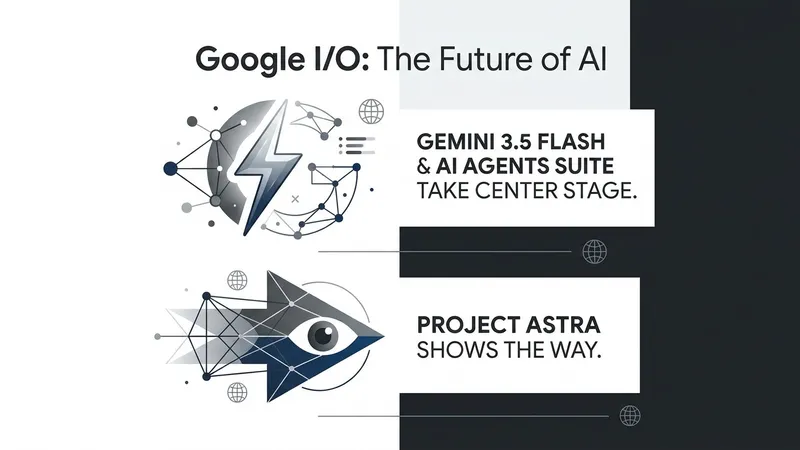
At the latest Google I/O conference, Artificial Intelligence (AI) and AI Agents completely took over the spotlight. With the debut of Gemini 3.5 Flash, the powerful upgrade of Gemini 3.1 Pro, and the rollout of Google’s comprehensive "Agent Suite," the traditional Android operating system appears to be taking a backseat—or rather, undergoing a radical architectural rebirth driven by AI Agents.
The evolution of the Gemini model family remains the cornerstone of Google’s strategy. The newly launched Gemini 3.5 Flash has captured a highly competitive position in performance and latency metrics. Meanwhile, Gemini 3.1 Pro has doubled its reasoning scores and lowered hallucination rates under the same pricing structure, serving as a robust foundation for enterprise, education, and content creation workflows.
In terms of the Agent ecosystem, Google demonstrated deep vertical integration. Project Astra, Google's vision for the future of multimodal AI assistants, received major upgrades. Concurrently, Google Play deployed "Sidekick," an in-game AI assistant powered by Gemini. Currently supporting over 90% of popular mobile games, Sidekick showcases how Agents are transitioning from generic chat interfaces to highly specialized, context-aware vertical applications.
For Android, this shift redefines the very essence of a mobile OS. Integrated deeply within Android 15, Gemini enables the device to transition from a passive app launcher to an proactive, Agent-driven system. Users will no longer need to hop between disjointed apps; instead, natural language intents will be automatically orchestrated and executed by native system Agents across different applications.
[AgentUpdate Depth Analysis] Google's integration of Gemini 3.5 and the Agent Suite into the core of Android 15 marks a pivotal shift from an App-centric OS to an Agent-centric OS. Contrasting this with competitors, while OpenAI leads in raw frontier models, it lacks a native hardware/software OS hook to execute complex, cross-app workflows without friction. Apple Intelligence, on the other hand, emphasizes on-device privacy but is currently more conservative in orchestration capabilities. Google’s play leverages its full-stack advantage: state-of-the-art models, the world’s most dominant mobile OS, and a massive developer ecosystem via Google Play. By establishing Gemini as the native runtime engine, Google solves the "Action bottleneck" in AI Agent design. This forces developers to rebuild services not as standalone apps, but as discoverable APIs for system-level Agents, redefining the future of digital interaction.