While video conferencing tools keep us connected, users can still struggle to feel fully included in the conversation. Trying to read subtle emotions in a sea of tiny display boxes may leave remote participants feeling like mere observers rather than engaged collaborators. Google Beam, our true-to-life video communication platform, helps solve this critical challenge by turning your hybrid meetings into a much more active and natural exchange.
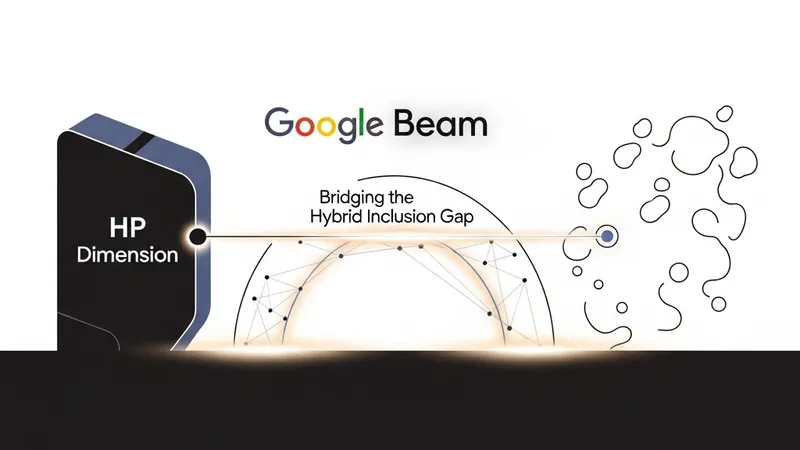
Today, we are sharing a brand-new experiment that brings elevated group meetings to Google Beam across an expanded range of devices. Utilizing HP Dimension's immersive display, Google Beam renders remote participants who join from non-Beam devices in their actual, true-to-life size, positioned as though they are sitting right around a physical table with you. When paired with advanced spatial audio that anchors each voice directly to the person speaking, your colleagues look, sound, and feel as if they are sharing the exact same physical space.
This intelligent optimization happens automatically, regardless of whether you join a meeting from home or the office. Google’s research indicates that these spatial approaches actively help close the hybrid 'inclusion gap' by facilitating a 50% stronger sense of social connection and delivering a 21% increase in participants' reported ability to contribute meaningfully to conversations.
We are also continuing our strategic collaboration with Google Workspace and Zoom to further elevate and enrich the standard meetings you conduct on Google Beam today.
[AgentUpdate Depth Analysis] Google Beam's spatial optimization represents a crucial bridge toward the future of embodied AI Agent integration. While platforms like Apple Vision Pro focus on isolated, headset-based virtual reality, Beam offers a shared physical telepresence that leverages spatial audio and life-sized rendering. For the emerging AI Agent ecosystem, this technology solves a major bottleneck: how digital agents transition from flat UI chat boxes into 3D collaborative environments. By providing a naturalistic 'seat at the table,' Beam establishes a spatial framework where multi-modal AI Agents can co-exist alongside human teams with full physical reference. This layout significantly lowers cognitive friction in human-agent collaboration and paves the way for advanced multi-agent workflows where AI and humans negotiate, present, and collaborate in unified, perceptually seamless spaces.