Every Google I/O has its headline magnet. A faster model, a shinier demo, a new capability that makes developers excited. Google I/O 2026 had plenty of those: Gemini 3.5 Flash arrived with serious benchmark energy, and WebMCP gave the open web crowd something ambitious to debate. AI Studio, Chrome, Search, and Gemini all moved deeper into agentic territory.
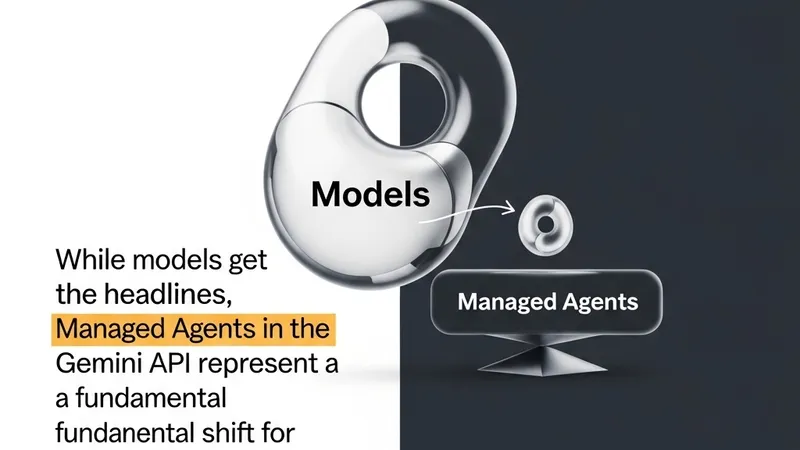
But the most important developer announcement was not the loudest one: it was the Managed Agents in the Gemini API. While models are the engines, Managed Agents represent the chassis, gearbox, dashboard, and the emergency brake. It is the layer that turns “the model can reason” into “my application can ask an agent to do useful work, observe what it did, preserve state, and collect artifacts.”
For the last couple of years, the bottleneck was never intelligence; it was the runtime. Agent demos followed a mundane script of planning, coding, and self-fixing, but developers building for production immediately hit a wall. A serious agent needs a workspace—a sandbox, files, tool boundaries, and memory. It needs observable intermediate steps and controls for network access, credentials, and cost, so that every team doesn't have to rebuild the same orchestration layer from scratch.
This is the gap Managed Agents tries to close. Google is packaging the agent loop itself as a managed developer primitive. With Managed Agents, the Antigravity agent can run inside a Google-hosted Linux environment, execute code, manage files, and use web access, all while preserving environment state. It shifts the developer’s job: instead of building the whole runtime, you start from a hosted agent environment and focus on the product boundary.
At I/O 2026, Google introduced Managed Agents in the Gemini API, with the Antigravity agent (powered by Gemini 3.5 Flash) available as a public preview. This suite is exposed through the Interactions API and Google AI Studio, representing a shift toward making agentic workflows a standard part of the developer stack.