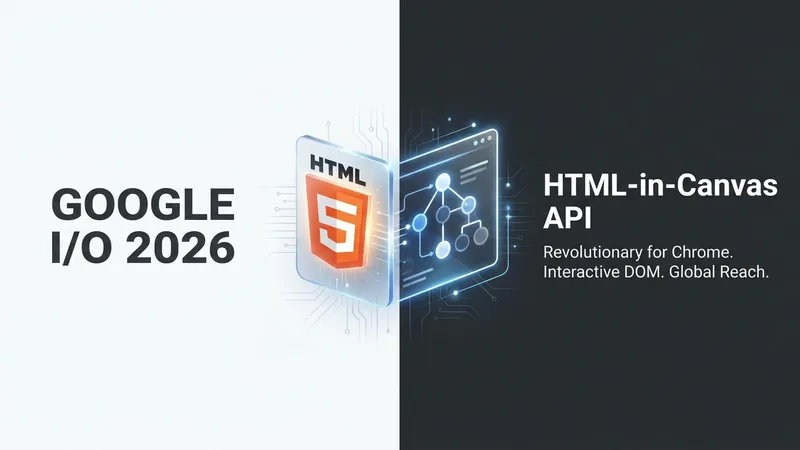
Among the major announcements at Google I/O 2026, the new HTML-in-Canvas API for Chrome stands out as a transformative update for the modern web platform. While it might appear as a minor rendering tweak, it represents a fundamental shift for graphics-heavy and real-time web applications.
For years, developers have faced a binary choice: the DOM or the Canvas. The DOM (HTML/CSS) offers native accessibility, text selection, SEO, and browser translation. In contrast, Canvas—along with WebGL and WebGPU—provides high-performance GPU rendering, particle systems, and immersive gaming experiences. The historical limitation of Canvas is that once content is rendered, it becomes mere pixels, losing interactivity and accessibility features. Developers often had to rebuild UI systems from scratch within the graphics buffer.
Google’s new HTML-in-Canvas API bridges this gap by allowing actual DOM elements to be rendered within Canvas-rendered environments while preserving native browser features. This is particularly crucial for developers working on real-time maps, multiplayer interactions, and spatial interfaces.
For projects like the map-based social app BirdInk, this technology enables accessible map labels, interactive profile cards, and searchable text within GPU-accelerated scenes. It eliminates the messy workaround of layering HTML on top of a canvas and manually synchronizing coordinates. Similarly, in real-time chat systems or multiplayer games, developers can now combine GPU-powered visuals with accessible, HTML-based interfaces effortlessly.
This advancement ensures that as the web becomes more immersive and visually complex, it remains interactive and accessible, marking a new era for high-performance web graphics and interactive social experiences.