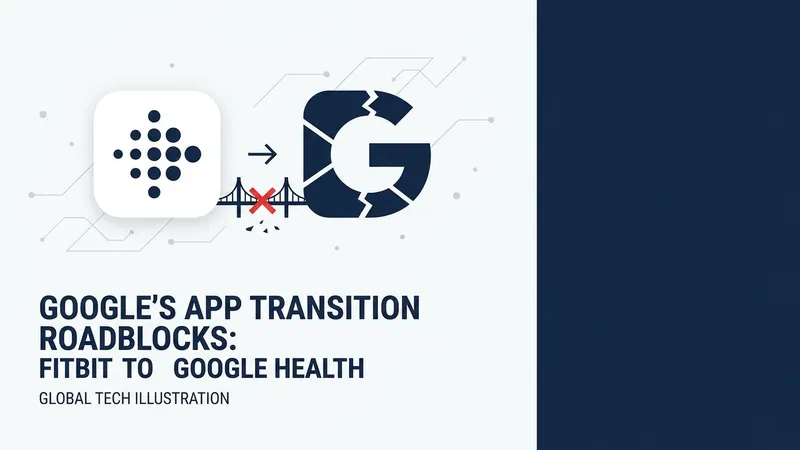
Google's recent transition from the Fitbit app to the newly branded Google Health has encountered significant user dissatisfaction and technical hurdles. Introduced alongside the Fitbit Air, a screenless fitness tracker designed to compete with Whoop, the original Fitbit app has been retired, with Google Health taking its place as the primary health management platform. However, many of the changes accompanying this shift, particularly the heavy integration of AI features, have become a source of widespread problems.
The AI-intensive nature of the Google Health app has led to a poor user experience, manifested in several critical issues:
- Incorrect and Inconsistent Data: Health data points were often wrong or showed discrepancies across different sections of the app.
- Mislabeled Workouts: Activities like running were incorrectly categorized as "general activity."
- Missing Sleep Scores: Users reported the absence of sleep scoring data.
- Duplicative Content: Repetitive information appeared within the application.
- Verbose and Sycophantic AI Summaries: AI-generated summaries of health data were excessively long, often lacking actionable insights, and perceived as overly flattering.
- Frequent App Crashes: Users experienced random and unexpected application crashes.
Beyond functional glitches, the user interface of the new Google Health app has also drawn criticism. Many users on platforms like Reddit have described the new interface as "noisy" and difficult to navigate, hindering effective information retrieval. While UI preferences are subjective, it's clear Google's redesign has not resonated positively with a substantial portion of its user base.
In response to the deluge of user feedback, Google has taken urgent action. The company acknowledged these bugs in an official blog post, detailing planned fixes that are expected to roll out over the coming week. However, it remains uncertain whether these rectifications will fully placate disgruntled users. Past incidents, such as the Sonos app debacle and Google's own Nest app migration, demonstrate that poorly executed app transitions can leave a lasting negative impression. Moreover, with an expanding array of alternative health wearables and platforms available, users have ample options to switch if their experience does not improve.
It's worth noting that this isn't Google's first problematic app migration. A similar backlash occurred when Google attempted to transition Nest users from the dedicated Nest app to the Google Home app. It took years for the Google Home app to achieve feature parity with its predecessor, and for some inexplicable reasons, the Nest app still hasn't been fully discontinued, underscoring Google's recurring challenges in large-scale application ecosystem integration.
[AgentUpdate Depth Analysis]
The troubled launch of Google Health, particularly the issues stemming from its AI features, offers crucial insights for the evolving AI Agent ecosystem. While the promise of AI Agents lies in their autonomous understanding, planning, and execution, especially in sensitive domains like personal health, this incident highlights critical vulnerabilities. The errors in AI summaries, data consolidation, and categorization expose limitations in current AI Agent capabilities regarding domain knowledge depth, transparency of decision logic, and cross-modal data consistency. Future AI Agents in health management must incorporate more robust self-correction mechanisms and learning from human feedback (RLHF) to enhance accuracy and trustworthiness. Compared to specialized health AI agents (e.g., dedicated sleep trackers), Google Health's comprehensive approach necessitates a delicate balance between generalization and specialization for its embedded AI. This event underscores the imperative for Agent developers to prioritize the robustness and user validation of AI systems, propelling AI Agent technology towards more mature, reliable, and interpretable real-world deployments.