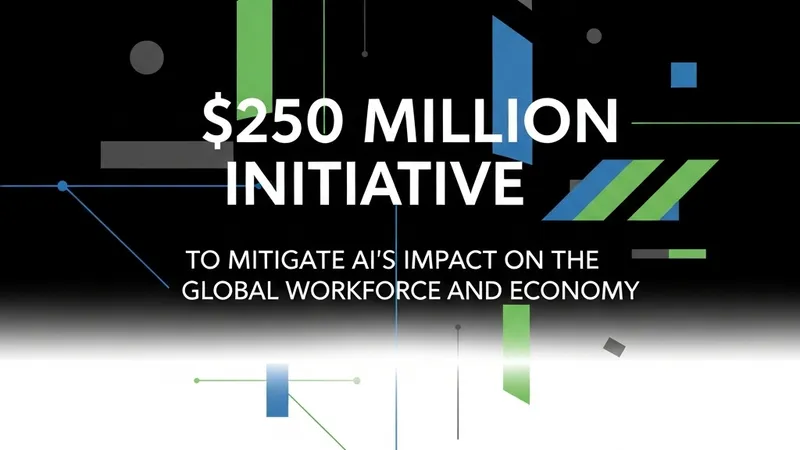
The OpenAI Foundation announced its commitment of an initial $250 million to launch a global initiative aimed at helping workforces and economies adapt to the profound disruptions brought about by artificial intelligence technologies. This marks the first significant funding commitment from the nonprofit organization that governs OpenAI.
The foundation stated that the funding will primarily support labor-market research, programs for workers and communities facing near-term displacement, and projects exploring mechanisms for broader distribution of AI's economic gains. This announcement comes amidst growing global concerns regarding AI's impact on employment across diverse sectors, including software engineering, finance, customer service, and media.
According to the OpenAI Foundation, the rapid pace of AI technological change has compressed the timeframe for governments, businesses, and nonprofit groups to effectively respond to labor market disruptions. Failure to address these challenges, they emphasized, could lead to significant consequences for workers and local economies.
Moving forward, the foundation intends to directly operate some programs, rather than solely acting as a grantmaking organization. Its initial initiatives are slated for announcement later this year as its operational team expands.
Notably, the OpenAI Foundation secured a 26% stake in OpenAI's for-profit entity during a restructuring completed last year. Reuters estimated this holding to be worth approximately $130 billion at the time, positioning the organization among the world's largest charitable foundations linked to emerging technology.
Concerns over AI-driven job displacement have intensified as companies increasingly attribute workforce reductions to automation gains. Recent examples include financial technology firm Block and banking group Standard Chartered, both of which cited AI efficiencies in their restructuring efforts involving layoffs.
Additional reporting from Bloomberg highlighted OpenAI's earlier commitment to invest at least $1 billion through its nonprofit arm into projects focused on public-interest applications of artificial intelligence, including scientific research and community programs. Furthermore, a report by The Wall Street Journal underscored rising anxieties in the labor market regarding AI systems replacing entry-level office roles and reducing demand for junior workers in tech and finance. The publication also noted a surge in internal testing of AI-powered workflow tools by various firms over the past year.
Simultaneously, governments across the United States, Europe, and Asia are increasing scrutiny of AI regulation while striving to maintain competitiveness in this burgeoning sector. Policymakers are actively debating safeguards concerning labor protections, copyright issues, national security, and economic inequality associated with AI adoption.
This evolving landscape has intensified pressure on leading artificial intelligence companies to demonstrate broader public benefits from their innovations.
[AgentUpdate Depth Analysis] The OpenAI Foundation's $250 million initiative transcends a mere philanthropic gesture; it represents a strategic acknowledgment and proactive mitigation effort for the societal ramifications of an evolving AI Agent ecosystem. As AI Agents – from autonomous coding assistants to intelligent customer service bots and automated operational tools – become increasingly sophisticated and autonomous, they are poised to automate tasks far beyond traditional software, leading to profound workforce disruptions. This move by OpenAI sets a crucial precedent for other AI giants and Agent developers, emphasizing that a responsible and sustainable Agent ecosystem development is paramount. By focusing on workforce transition and economic distribution, OpenAI is effectively laying groundwork to minimize potential social friction as Agent technologies become ubiquitous. This foresight encourages Agent developers to integrate social adaptability and reskilling considerations into their design principles, moving beyond pure efficiency. Ultimately, this initiative could accelerate the maturation of "human-AI collaboration" models rather than simple "human-AI replacement," fostering a more inclusive integration of AI Agents into society. It stands as a distinctive approach compared to broader "responsible AI" principles from Meta or Google, by directly addressing labor market impacts, offering an insightful blueprint for a more equitable AI Agent future.