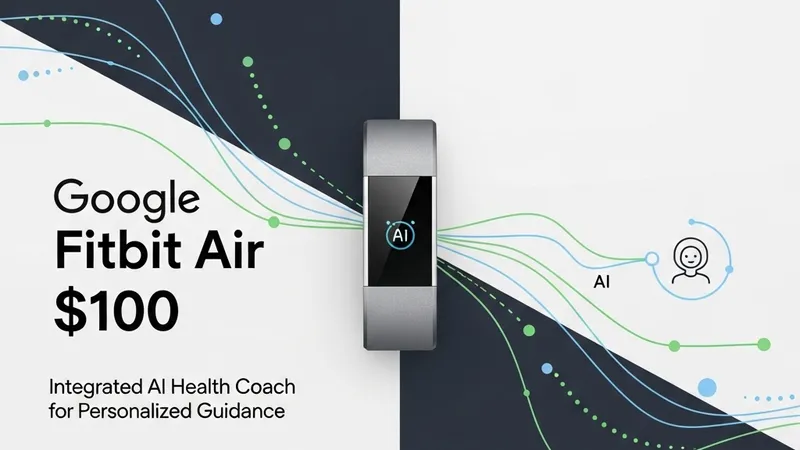
Google has officially unveiled the Fitbit Air, a sleek, screenless wearable priced at a highly competitive $100. Mimicking the minimalist, display-free aesthetic popularized by Whoop, the device pivots entirely away from traditional screens, positioning a deeply integrated Generative AI Health Coach as its defining value proposition to challenge the premium wearable market.
The Fitbit Air is powered by a fine-tuned version of Google's Gemini LLM, optimized specifically for physiological and medical data. By continuously monitoring critical biometrics—including Heart Rate Variability (HRV), skin temperature, sleep cycles, and physical exertion—the device moves beyond passive data tracking. Instead of presenting users with complex, hard-to-interpret charts, the AI Coach translates these metrics into proactive, conversational guidance, advising users on how to balance recovery and daily stress in real time.
With a $100 price tag, Google is taking a direct swipe at Whoop’s expensive subscription model. While Whoop has secured a niche among elite athletes with raw physiological metrics, Google leverages its cloud-based AI infrastructure to democratize coaching. The Fitbit Air effectively shifts the wearable paradigm from a passive tracking tool to an active health proxy, with the AI acting as an omnipresent, personal exercise physiologist.
[AgentUpdate Depth Analysis] The debut of Fitbit Air marks a pivotal moment where AI Agents transition from digital web interfaces into ambient, physical hardware. Unlike traditional wearables that merely act as passive telemetry devices, Fitbit Air introduces a proactive "Health Agent" equipped with long-term contextual memory and multi-modal reasoning. Within the broader AI Agent ecosystem, wearables are evolving from simple peripherals into the essential "sensory nervous system" of personal LLMs. This integration bridges the gap between raw data collection and autonomous, actionable lifestyle interventions. As edge-computing and low-power sensors mature, the synergy between affordable hardware and sophisticated cloud-based agents will likely set a new benchmark for consumer electronics and the future of personalized AI companions.