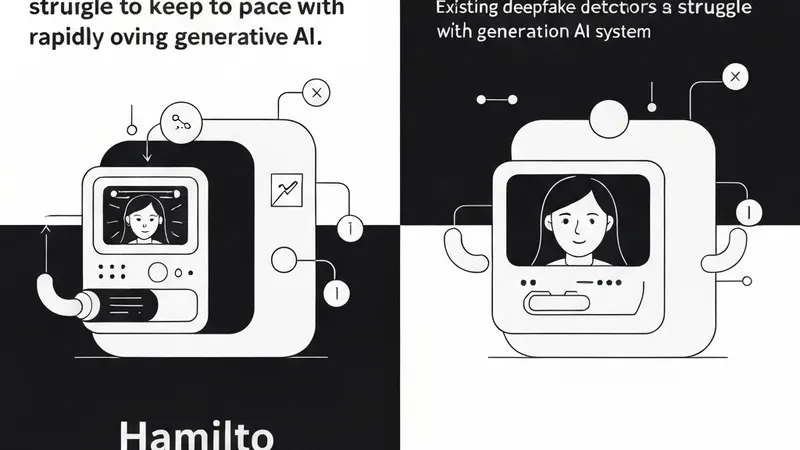
The rapid advancement of generative AI models has necessitated continuous recalibration of deepfake detectors to keep pace with evolving synthetic artifacts. Researchers are now proposing a novel approach that shifts deepfake detection from static pattern recognition to dynamical stability analysis, aiming to break this ongoing cycle of detection and adaptation.
This new perspective is rooted in physics-inspired priors. The core hypothesis posits that natural images, resulting from dissipative physical processes, naturally gravitate towards stable, low-energy equilibrium states. Conversely, generative models, while excelling at statistical similarity to real images, often fail to explicitly enforce critical structural constraints like geometric smoothness. This inherent limitation suggests that deepfakes are more prone to occupying unstable, high-energy states within an image's latent representation.
To operationalize this theory, a new method called Hamiltonian Action Anomaly Detection (HAAD) has been introduced, built upon three key contributions. Firstly, HAAD models the image latent manifold as a potential energy surface. Within this framework, real images are hypothesized to correspond to basin-like, low-energy responses, whereas deepfakes are expected to exhibit high-potential, high-gradient responses.
Secondly, HAAD utilizes Hamiltonian-inspired dynamics as a stability probe. When latent states are "released" from rest within this potential energy landscape, samples originating from stable regions—characteristic of real images—tend to remain bounded in their trajectories. In contrast, high-gradient samples—indicative of deepfakes—produce significantly larger trajectory responses, signaling their inherent instability.
Finally, the dynamic behaviors observed are quantified using two specific trajectory statistics: Hamiltonian action and energy dissipation. Extensive experimental evaluations demonstrate that HAAD significantly outperforms existing state-of-the-art baselines, particularly on challenging cross-dataset transfer benchmarks. These findings strongly support the efficacy of a physics-inspired stability prior, offering a robust new direction for digital forensics in combating deepfakes.