In the realm of high-capacity events—be it the World Cup or a sold-out stadium concert—the critical distinction between a "good" and a "dangerous" experience often boils down to one factor: timely and accurate information.
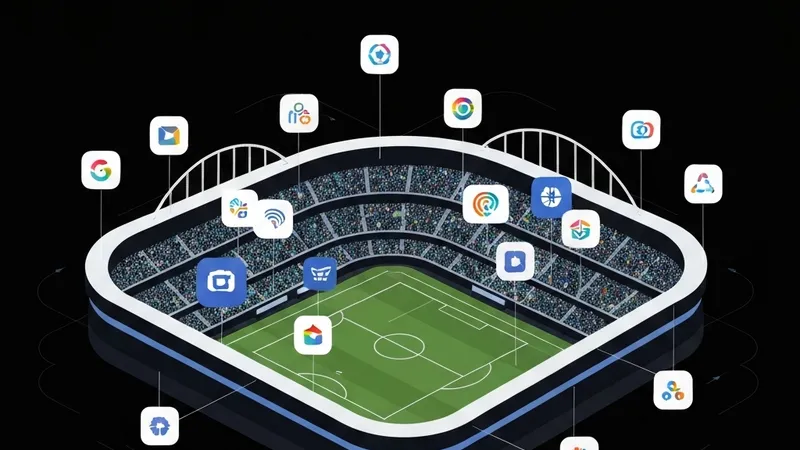
When thousands of individuals move simultaneously, bottlenecks inevitably form, amenities like restrooms become overwhelmed, and safety risks escalate. CrowdFlow AI was developed precisely to address these challenges head-on. Beyond merely creating an application, we engineered a high-performance ecosystem powered by the comprehensive capabilities of the Google Cloud Portfolio.
This report offers an in-depth look into how we leveraged over 11 distinct Google services to construct the future of intelligent stadium management.
🏗️ The Core Problem: Congestion & Information Silos
Most stadiums operate as "silent" entities; they lack real-time communication channels with fans. An attendee might wait 20 minutes for a burger on the South side, oblivious to an empty stall on the North side.
CrowdFlow AI empowers the stadium with a voice, transforming it into a responsive, communicative environment.
☁️ The Powerhouse: Deconstructing 11+ Google Services
1. 👁️ Google Cloud Vision API: The Stadium's Eyes
This API serves as our core data ingestion engine. When a stadium attendee reports an incident, such as a blocked egress point, they upload a photo. Our backend processes this image via the Cloud Vision API, which performs the following functions:
- Object Localization: The system accurately detects individual "Person" objects within the uploaded photo.
- Dynamic Risk Profiling: Based on the detected person count, we automatically assign a density tag: 🟢 LOW, 🟡 MODERATE, or 🔴 OVERCROWDED.
- Latency Optimization: Prior to upload, our frontend employs a custom HTML5 Canvas script to downscale images from 12MB to approximately 150KB. This ensures the "Eye" receives and processes visual information efficiently, even under strained 4G network conditions.
2. 🤖 Google Vertex AI (Gemini 1.5 Pro): The Stadium's Brain
Our Smart Assistant Chatbot is not a static script but a dynamic, living AI. Utilizing Gemini 1.5 Pro, we've meticulously engineered a prompt that transforms the Large Language Model (LLM) into a highly specialized stadium expert.
- It intelligently predicts potential crowd surges by analyzing historical trends and real-time data.
- It provides instant, accurate answers to real-time fan queries, such as "Where is the VIP parking area?" or "Help, I'm disoriented near Section 4!"
3. 🗺️ Google Maps & Places API: The Stadium's Dynamic Map
A static map becomes counterproductive if it directs users into congested areas. We integrated the Maps JavaScript SDK with a crucial enhancement:
- Smart Rerouting: Leveraging the Directions API, we calculate optimal paths that actively guide users away from "Hot Zones" identified and flagged by our Vision API.
- Places Integration: We utilize the Places API to instantaneously locate and display every amenity (restrooms, food stalls, ATMs) within the stadium complex.
4. 🌐 Google Cloud Translation API: The Stadium's Voice
Given India's linguistic diversity, a truly smart stadium must communicate effectively in multiple languages.
- We have seamlessly integrated the Cloud Translation API to provide one-click UI language switching for Hindi, Bengali, Telugu, Marathi, Tamil, and Gujarati.
- This functionality extends beyond static text labels; it translates the Live Incident Feed in real-time, ensuring that every fan receives critical emergency alerts in their native tongue.
5. 🚀 Google Cloud Run: The Stadium's Heart
We selected Google Cloud Run for its inherent serverless scalability.