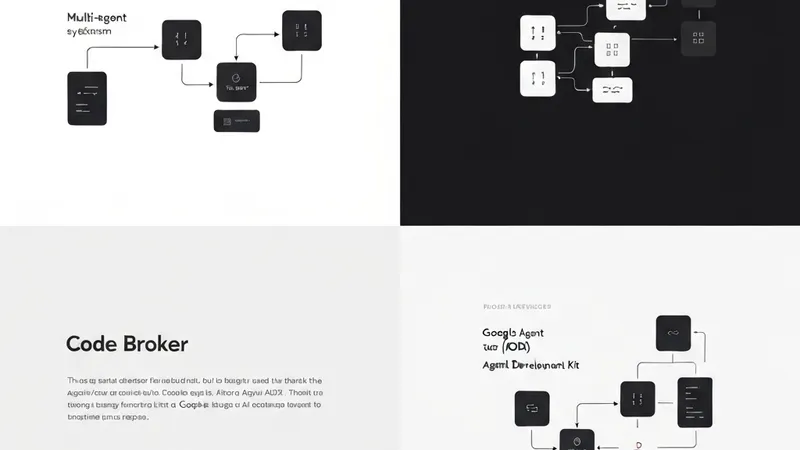
Code Broker is a multi-agent system developed using Google’s Agent Development Kit (ADK), designed for automated Python source code quality assessment. It analyzes code from individual files, local directory trees, or remote GitHub repositories, generating structured and actionable quality assessment reports.
The system employs a hierarchical five-agent architecture. A root orchestrator coordinates a sequential pipeline agent, which then concurrently dispatches three specialized agents: a Correctness Assessor, a Style Assessor, and a Description Generator. Their collective findings are subsequently synthesized by an Improvement Recommender.
Assessment reports quantify four critical quality dimensions—correctness, security, style, and maintainability—on a normalized scale. These reports are rendered in both Markdown and HTML formats, facilitating integration into various developer workflows.
Code Broker innovatively fuses LLM-based semantic reasoning with deterministic static analysis signals, such as those from Pylint. To enhance robustness against transient API failures, it utilizes asynchronous execution coupled with exponential backoff retry logic. Furthermore, the system incorporates lightweight session memory to retain and query previous assessment contexts across multiple runs.
This initiative is framed as a technical report focusing on system design, prompt engineering, and tool orchestration. It includes a preliminary qualitative evaluation conducted on representative Python codebases of varying scales.
The evaluation results highlight that the parallel specialized agents deliver readable, developer-oriented feedback that effectively complements traditional linting. The report also candidly addresses current limitations, specifically in evaluation depth, security tooling integration, handling of large repositories, and the exclusive reliance on in-memory persistence. All associated code and reproducibility materials are publicly available.