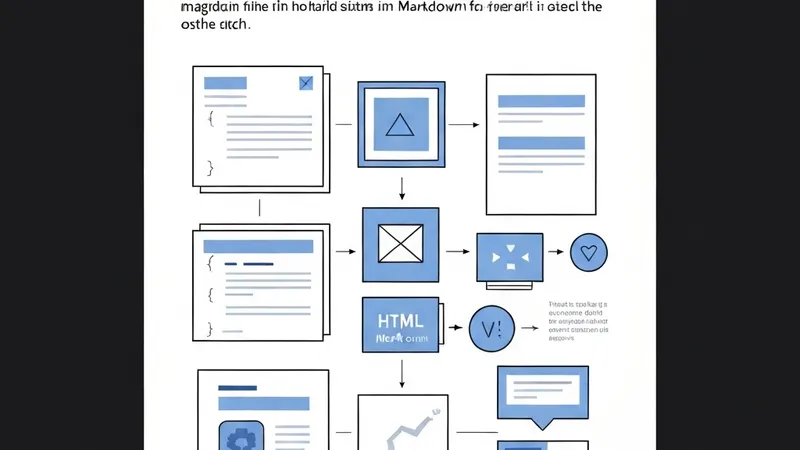
Thariq Shihipar from Anthropic's Claude Code team recently penned a thought-provoking piece advocating for HTML over Markdown as the preferred output format when prompting Claude, highlighting HTML's "unreasonable effectiveness" in AI-generated content.
The article features numerous insightful examples and prompt suggestions, such as this one:
"Help me review this PR by creating an HTML artifact that describes it. I'm not very familiar with the streaming/backpressure logic so focus on that. Render the actual diff with inline margin annotations, color-code findings by severity and whatever else might be needed to convey the concept well."
Since the GPT-4 era, with its 8,192 token limit, the author had defaulted to requesting most outputs in Markdown due to its superior token efficiency compared to HTML. However, Thariq's article prompted a reconsideration, especially for output formats. Requesting Claude to provide explanations in HTML enables the AI to embed SVG diagrams, interactive widgets, in-page navigation, and a variety of other sophisticated methods to make information more engaging and easier to digest.
Last December, the author wrote about "Useful patterns for building HTML tools," though that work primarily focused on interactive utilities, similar to those found on his tools.simonwillison.net site. Now, he expresses excitement about further experimenting with rich HTML explanations generated in response to ad-hoc prompts.
To test this concept, the author experimented on copy.fail, a site describing a recently discovered Linux security exploit, including a proof of concept distributed as obfuscated Python. He attempted to have GPT-5.5 create an HTML explanation of the exploit using the following command:
curl https://copy.fail/exp | llm -m gpt-5.5 -s 'Explain this code in detail. Reformat it, expand out any confusing bits and go deep into what it does and how it works. Output HTML, neatly styled and using capabilities of HTML and CSS and JavaScript to make the explanation rich and interactive and as clear as possible'
The resulting HTML page was quite good. While the author noted that emphasizing the exploit itself over its surrounding Python harness would have been beneficial, the experiment successfully demonstrated HTML's significant potential in enhancing AI-generated explanations.