In the golden age of AI-assisted software engineering, developers often encounter a bizarre "Hour-Three breakdown": during the first two hours, the AI acts like an omniscient software architect, churning out boilerplate and feature code. But by hour three, as the codebase expands and conversation turns accumulate, the AI begins to lose its grip. It starts introducing endless regressions, forgetting established architectural patterns, and falling into the dreaded loop of "fixing A to break B, and fixing B to break A." This phenomenon is highly apparent even when using state-of-the-art terminal-based agents like Anthropic's Claude Code.
Why do AI coding sessions fall apart over time? The root cause lies in "Context Drift" and "Cumulative Error." As the agent's context window gets flooded with stack traces, failed terminal executions, and intermediate trials, the global mental model of the codebase fades. Unlike human developers, LLMs lack a persistent, abstract cognitive map of the system. Every subsequent prompt forces the AI to re-evaluate the codebase, leading to a steady decay of structural integrity and implicit assumptions.
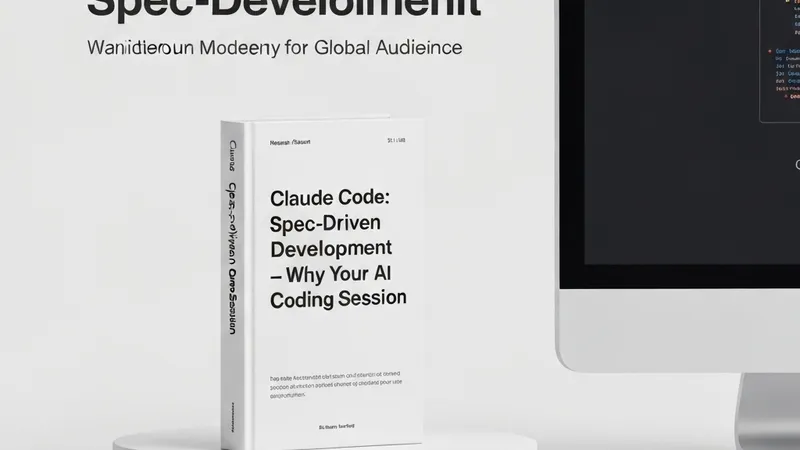
To overcome this limitation, developers are turning to "Spec-Driven Development" (SDD)—a methodology tailored for the AI agent era. Under SDD, before Claude Code touches a single line of production code, a rigorous and immutable specification file (e.g., `spec.md`) must be defined. This file does not merely outline requirements; it strictly details the system architecture, data models, API contracts, edge cases, and hard constraints (such as "no external state libraries").
Under this paradigm, the agentic capabilities of Claude Code—such as file manipulation, running CLI tools, and executing test suites—are fully unlocked. The development workflow becomes a strict loop: edit the Spec, command Claude Code to generate tests based on the Spec, implement the code to pass those tests, and iteratively refine the Spec if the architecture pivots. By anchoring the agent to a single "Source of Truth," you prevent the context decay that inevitably derails long-term agentic programming sessions.
[AgentUpdate Depth Analysis] The rise of autonomous CLI agents like Claude Code signals a tectonic shift from passive "Copilots" to proactive "Agentic" developers. However, the ultimate bottleneck is no longer LLM reasoning power, but rather state management and architectural coherence over extended runtimes. Spec-Driven Development (SDD) acts as a deterministic "compiler" for non-deterministic LLM behaviors. It redefines the human programmer's role from writing implementation details to curating systemic specifications. As the Model Context Protocol (MCP) gains industry adoption, Spec-driven workflows will likely become the standardized interface for multi-agent collaboration, safeguarding long-running software agents from cognitive collapse and bringing us closer to true autonomous software engineering.